In the city of Dongyang, in Zhejiang Province, China, a peculiar culinary tradition attracts attention and sparks controversy: the “Virgin Boy Egg.” The dish, considered a local delicacy, is made with eggs boiled in the urine of young boys under 12 years old. Locals say this practice dates back generations and is deeply rooted in the region’s culture.

The preparation takes nearly an entire day. First, the eggs are boiled in a pot filled with fresh urine, collected mainly from primary schools. Then, the shells are cracked, and the eggs are boiled again for several hours. During this time, vendors add more urine and carefully control the fire. The result is a strong-smelling and distinctive-tasting food sold on the streets during springtime — the season when, according to locals, the “Virgin Boy Egg” reaches its best quality.
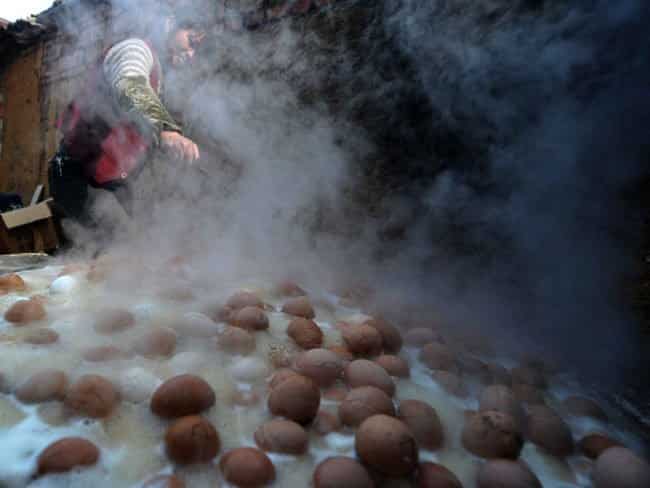
Many residents regard the delicacy as a “spring tonic.” They believe it can reduce body heat, improve blood circulation, and prevent heatstroke. Some also claim that eating it “reinvigorates the body” and prevents the drowsiness typical of spring. “The elders say that eating these eggs prevents heatstroke in summer and drowsiness in spring. Most people in Dongyang have eaten them,” a local resident told reporters.
The tradition is held in such high esteem that, in 2008, the Dongyang city government listed the ‘Virgin Boy Egg’ as an item of Intangible Cultural Heritage. It was recognized as part of the city’s gastronomic legacy. According to Gong Mingwei, a resident and supporter of the practice, “Cooking and offering boys’ urine eggs is a spring custom, just like the rice dumplings of the Dragon Boat Festival and the mooncakes of the Mid-Autumn Festival. They have become a gift from the people of Dongyang to friends and relatives.”
However, the tradition is not without controversy. Experts in health and Traditional Chinese Medicine have different opinions about the dish. Li Xianjun, president of the Jinxin Hospital of Traditional Chinese Medicine in Chengdu, stated that “boys’ urine has no nutritional value from a medical point of view.” He acknowledges that boiling at high temperatures removes the risk of bacteria, but warns that there are no proven benefits. “From a medical perspective, I still do not support eating boys’ eggs,” he emphasized.
While some residents defend the practice as a cultural and medicinal expression, others see it as unsanitary and outdated. On online forums, consumers share mixed experiences: “The taste is sweet and fragrant,” wrote one fan of the dish. Another commented, “It’s so salty that I can’t eat it.”
Between fascination and rejection, the ‘Virgin Boy Egg’ continues to divide opinions. It stands as a symbol of how regional traditions can challenge the boundaries between culture, health, and modernity.
Source: News.Sina