Robot reaches record speed, but test details spark debate.
📌 What you need to know:
• Record: Unitree’s H1 robot reached 10.1 m/s, nearly matching Usain Bolt’s average speed.
• Modifications: To achieve the speed, the robot ran without its head and hands, reducing weight.
• Future: Experts predict robots will break the 10-second barrier by mid-2026.
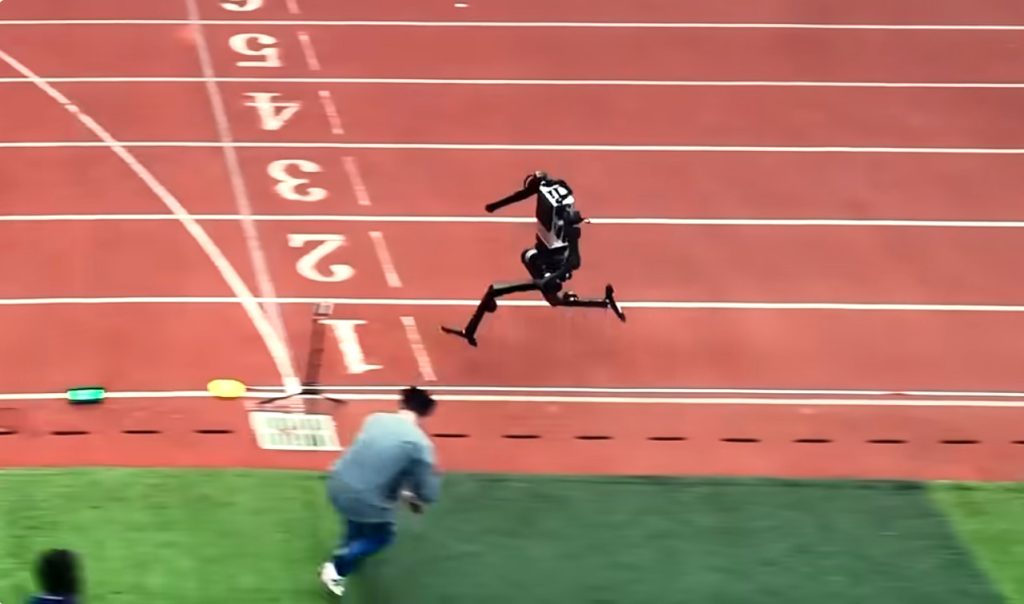
A humanoid robot developed in China has captured global attention after reaching around 10 meters per second while running, approaching the legendary speed of Usain Bolt in his historic 100-meter record.
🚀 World-class speed
The H1 robot, developed by Unitree Robotics, was designed to faithfully replicate human biomechanics — and the results are impressive.
Tested on an athletics track, the robot recorded approximately 10.1 meters per second, according to data released by the company, although there may be a margin of error in the measurement.
In a video published online, the company celebrated the achievement:
“10 m/s!! Unitree breaks the world record again. With the physique of an ordinary person, running at the speed of a world champion.”
Additionally, the company claims the footage was neither sped up nor generated by artificial intelligence, reinforcing the authenticity of the test. On the displayed timer, the final mark recorded was approximately 10.01 seconds for the 100-meter dash.
10m/s!! Unitree Breaks the World Record Again😊
— Unitree (@UnitreeRobotics) April 11, 2026
With the physique of an ordinary person, running at a world champion’s speed!
Leg length: 0.4+0.4=0.8m, body weight: approx. 62kg!
H1: “Give me one more chance, give the world one more honor!” pic.twitter.com/Fk4Zo9zKit
⚡ Direct comparison with Usain Bolt
To understand the impact, it’s worth remembering:
• Usain Bolt set the 100-meter world record at 9.58 seconds during the 2009 World Athletics Championships
• His average speed was approximately 23.35 mph (10.44 m/s)
➡️ In other words, the robot is already dangerously close to the performance of one of the greatest athletes in history.
📏 An almost human body
The H1 is not a small or simplified prototype. It was built with human-like proportions:
• Height: about 5’10” (1.78 m)
• Leg length: approximately 31.5 inches (80 cm)
• Weight: about 137 lbs (62 kg)
➡️ These characteristics make the comparison with humans even more striking, as the robot operates with dimensions very close to those of an adult.
⚙️ Technology behind the speed
The robot’s performance is the result of advanced engineering:
• High-torque motors in the joints
• Patented gear system
• Advanced sensors, including LiDAR and depth cameras
➡️ This combination enables balance, coordination, and propulsion close to real human movement.
⚠️ The detail few mention
Despite the impressive achievement, there is a crucial point:
For the high-speed test, some components were removed — including the robot’s hands and head.
According to information published by the website Chosun, the modification had a clear objective:
➡️ to reduce weight and air resistance, improving performance.
This means the robot was not in its full configuration, raising questions about direct comparisons with humans.
🤖 Technological race among robots
The competition is not limited to Unitree. Another Chinese company, MirrorMe, has also entered the race.
Its humanoid robot, called Bolt, features similar characteristics:
• Height: 5’9″ (5 feet 9 inches)
• Weight: 165 lbs
• Top speed: up to 22.37 mph (36 km/h)
➡️ This places the companies in direct competition for leadership in high-performance humanoid robotics.
🏁 Event could mark a new historic milestone
All eyes are now on the Humanoid Robot Half Marathon, scheduled for April 19.
• More than 70 teams have already conducted tests, including nighttime training
• The event will take place in the Beijing Economic-Technological Development Area
Analysts point out that this could be the most competitive event ever seen, with multiple robots running side by side.
🧠 Will robots surpass humans?
During the Yabuli Entrepreneurs Forum 2026, Unitree CEO Wang Xingxing made a bold prediction:
Humanoid robots may break the 10-second barrier in the 100 meters as early as mid-2026.
🔎 Impressive progress, but with caveats
The H1 robot represents a remarkable technological leap, bringing machines closer to a level of performance once exclusive to elite athletes.
However:
• The test involved optimized conditions
• The recorded speed may represent a peak performance
• And the robot was not fully assembled
➡️ Even so, the outlook is clear: the line between human and machine performance is becoming increasingly blurred.