What if an animal could hit the “reset” button on its own life?
What You Need to Know
- It reverses its life cycle. Under stress, the tiny Turritopsis dohrnii, just a few millimeters in size, forms a cluster of cells from which a polyp emerges within 1 to 3 days. This juvenile stage gives rise to new jellyfish.
- Its cells change function. Through transdifferentiation, certain adult cells change into different cell types and help form a new polyp.
- The secret lies in its DNA, but it may differ from ours. The jellyfish has extra copies of genes linked to DNA repair and telomere maintenance, but few correspond to markers of human stem cells.
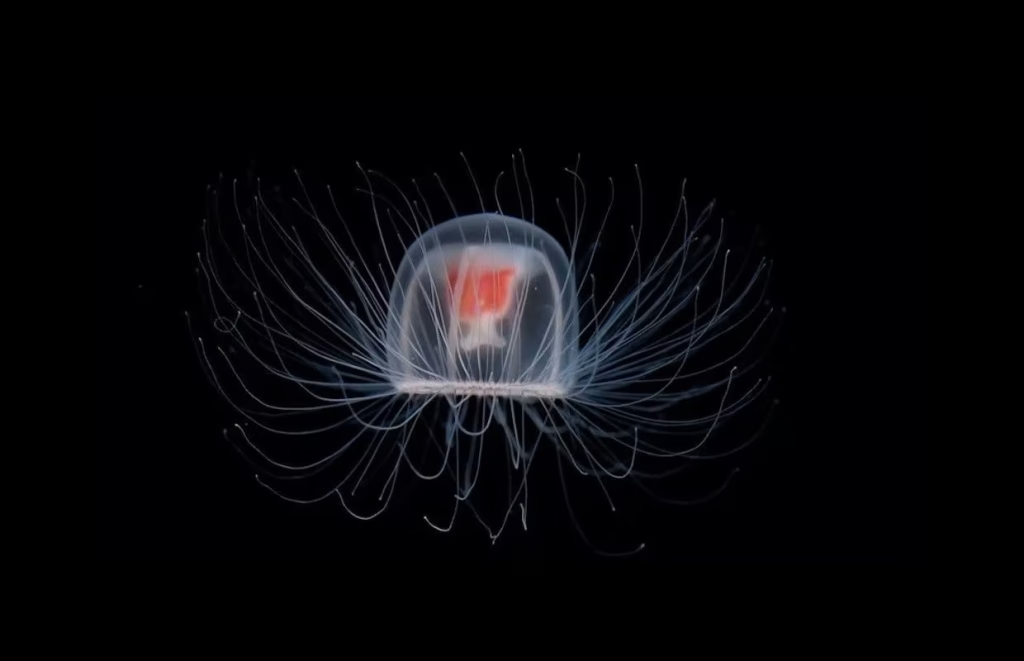
It measures just a few millimeters, it’s translucent, and it looks as fragile as a drop of water. Still, marine biologist Maria Miglietta of Texas A&M tried everything to kill Turritopsis dohrnii. She cut it, boiled it, starved it, flooded its tanks with salt, and swapped the water for freshwater. Time after time, the creature seemed to slip away from death.
The Impossible Trick
Under extreme stress, the adult jellyfish (the medusa, with its umbrella-shaped bell and tentacles) stops moving and sinks to the bottom of the tank. Then it collapses into a clump of cells that no longer resembles the original animal.
Within one to three days, that clump gives rise to a polyp, the earliest stage of a jellyfish’s life. The polyp grows into a colony capable of producing hundreds of new medusae from a single original medusa. In principle, each of these new medusae can repeat the process. It’s a biological clock that rewinds to youth, seemingly without end.
A Discovery Born From a Forgotten Feeding
The feat was first reported in 1992 by an Italian scientist who forgot to feed his animals over a weekend. He expected to find them dead. Instead, he found new polyps.
How Cells Turn Back Time
Normally, stem cells can become nerve cells, muscle cells, and other types. In the immortal jellyfish, some adult cells can switch roles through transdifferentiation, a mechanism studied by biologist Stefano Piraino of the University of Salento.
- Adult cells lose their specialization and revert to a less differentiated state.
- They then take on new roles, turning into other cell types.
- These changes help form a new polyp, the jellyfish’s juvenile stage.
Some lizards, worms, and amphibians can regrow body parts. But T. dohrnii can reverse its entire life cycle, going from adult back to polyp.
Clues in the DNA
A 2022 study compared T. dohrnii with a related species that can’t regenerate. The immortal jellyfish’s DNA carried more copies of genes tied to two functions:
- DNA repair, since damage accumulates with age.
- Telomere maintenance. Telomeres are the “protective caps” on the ends of DNA, which normally shorten over time.
Miglietta also found genes that are overactivated during the cyst stage, when cells change fate and form new polyps. Some have unknown functions. Others match genes associated with human longevity, suggesting shared biological pathways.
There’s a caveat, though. Japanese scientists sequenced the animal’s complete genome, using more than 1,500 clonal medusae to obtain enough DNA. They found that nearly 16% of its genes had no match in the UniProtKB database, and that few corresponded to markers associated with human pluripotent stem cells. In other words, the jellyfish’s “switch” may be very different from ours.
Medicine’s (Realistic) Dream
Nobody wants to turn seniors into babies, Benjamin Button-style. The real goal is regenerative biology. Oncologist Michael Koldobskiy of Johns Hopkins, who collaborates with Miglietta, dreams of finding the molecular “switch” for rejuvenation. If it exists in humans, it could help with:
- Wound healing and injured tissue repair.
- Recovery after strokes and heart attacks.
- Reversing age-related vision loss.
- Fighting neurodegeneration, such as Alzheimer’s disease.
“At the level of organs and tissues, it’s a very real possibility,” he says. For researcher Victor Quesada of the University of Oviedo, the point is different: “With many diseases, we assume there’s no going back. Maybe there is.”
Immortality Doesn’t Mean Invulnerability
The immortal jellyfish is fragile, too. According to Miglietta, some specimens kept in the lab appear unable to regenerate.
Scientists also don’t know whether there’s a limit to how many times the animal can rejuvenate before dying of old age, since the species is hard to keep in captivity. In the wild, it still faces predators, swings in plankton availability, and algae that smother its colonies.
Perhaps the most poignant lesson from this tiny creature lies in its contrast: it can start life over, but it can’t control everything that threatens its survival.
Sources and References
- BBC Future (2026). The rejuvenating secrets of the immortal jellyfish. Available at: bbc.com.
- NCBI / PMC (2019). Transcriptome Characterization of Reverse Development in Turritopsis dohrnii (PMCID: PMC6893190). Available at: PMC6893190.
- PASCUAL-TORNER, M. et al. (2022). Comparative genomics of mortal and immortal cnidarians unveils novel keys behind rejuvenation. Proceedings of the National Academy of Sciences (PNAS), 119(36), e2118763119. Available at: PMC9459311.
- HASEGAWA, Y. et al. (2022). Genome assembly and transcriptomic analyses of the repeatedly rejuvenating jellyfish Turritopsis dohrnii. DNA Research, 30(1), dsac047. Available at: PMC9835754.
- NCBI / PubMed (2022). Comparative genomics of mortal and immortal cnidarians unveils novel keys behind rejuvenation (PMID: 36037356 / PMCID: PMC9459311). Available at: PubMed.