Christian Klein is betting on “vibe coding” and argues that Europe’s largest software company won’t fall victim to AI, but will lead the change instead.
WHAT YOU NEED TO KNOW
- Bombshell prediction from SAP’s CEO: Christian Klein stated that AI could completely eliminate the need for human programmers at the company within just 3 to 4 years, thanks to “vibe coding” — where users simply describe a problem in natural language and AI builds the software on its own.
- Radical shift, but no mass layoffs: SAP doesn’t plan to cut overall headcount, but it will transform roles: less line-by-line coding and more focus on business acumen, product management, and AI-driven process design. The traditional software developer becomes optional.
- Skeptical market and mixed realities: Despite SAP shares falling roughly 35% in 2026, Klein bets that pairing AI with the company’s proprietary data and key partnerships with OpenAI and Anthropic will secure a competitive edge. Studies suggest the primary driver will be workforce reskilling.
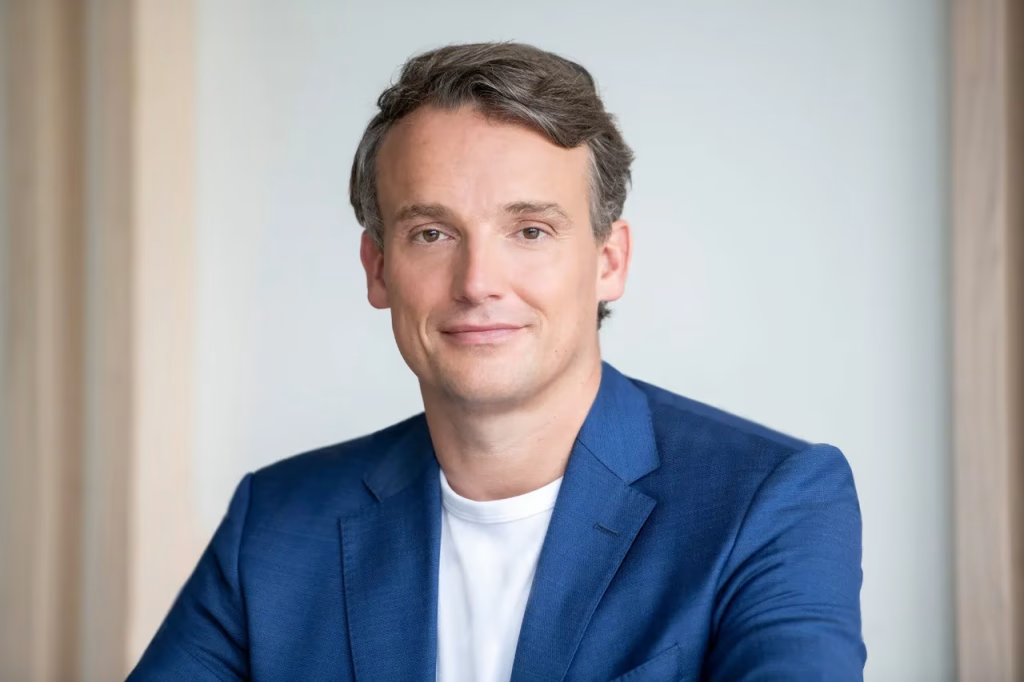
The CEO of SAP, Germany’s software giant and Europe’s largest company in the sector, said artificial intelligence could make his entire team of human developers redundant within three to four years.
The statement from Christian Klein, 46, was made in an interview with the Australian Financial Review during a visit to Australia, and quickly gained international attention.
Headquartered in Germany, SAP employs more than 110,000 people worldwide and has a market value of roughly $181.95 billion.
Despite the company’s size, Klein didn’t mince words: “Software development is the function most impacted by AI, and there’s a possibility that in three or four years, nobody will be developing software inside SAP anymore.”
What “Vibe Coding” Is — And Why It Could End the Programming Profession
According to Klein, this transformation runs on a specific mechanism: vibe coding.
These are AI tools capable of generating functional software from simple natural-language instructions — meaning the user doesn’t need any technical programming knowledge to use them.
Here’s how it works in practice: the user describes the problem they want to solve, and the AI builds the solution on its own. In this scenario, the role of the software engineer, traditionally responsible for writing code line by line, becomes optional.
SAP Won’t Be Cutting Jobs, But Roles Will Change
Despite the alarming tone of his prediction, Klein made clear that this shift doesn’t necessarily mean mass layoffs.
According to him, if SAP manages the transition well, the company may not need to reduce its overall headcount — but employees will need to adapt to new roles.
“We need product managers who understand code and who really understand the business. Demand for software developers is going down, but we need more data scientists, and we need to build ontologies so that agents understand how to run the business,” the executive explained.
In other words, SAP is describing a strategic shift: moving away from the idea that “building software means writing code” and toward “building software means designing business processes.”
The most valuable skill is no longer typing out commands — it’s understanding the business process, defining the expected outcome, organizing the data, and using AI to build the technical layer underneath.
Why Software Company Stocks Have Fallen So Much in 2026
Klein’s comments come at a difficult moment for the company. According to data from CompaniesMarketCap, SAP shares were trading at approximately $154.34 on July 22, down from about $236.27 at the start of 2026 — a decline of roughly 35% over the period.
The drop was driven by a sell-off that hit software-as-a-service companies (known by the acronym SaaS) worldwide, including Australia’s Atlassian.
The reason? Investors are questioning whether traditional software companies can survive competition from AI platforms that are increasingly capable of doing the same work. This trend has been dubbed the “SaaSpocalypse” — an apocalypse, however uncertain, for subscription-based software companies.
Still, Klein said he believes investors will return to betting on the SaaS sector soon.
According to him, SAP’s systems were built on proprietary customer data — company-specific information that, in his view, can’t easily be replaced by generic AI models.
SAP Sees OpenAI, Anthropic, and Mistral as Partners, Not Rivals
Contrary to what one might expect, Klein said he views major language-model companies — like Anthropic, OpenAI, and France’s Mistral — as partners rather than direct competitors to SAP.
According to him, these AI platforms don’t have access to the detailed business data that companies like SAP hold through their ERP systems (short for enterprise resource planning, the system that centralizes a company’s entire management operations).
That, he says, is precisely where SAP believes it holds an edge that’s hard to replicate.
Klein even cited a recent conversation with Anthropic’s own CEO: “A few weeks ago I was sitting with [Anthropic CEO] Dario [Amodei] and his leadership team, and they said SAP has something they don’t have, because we have AI that knows how to run businesses.”
For Klein, an ERP system works as “the brain of the company” — and that’s exactly the kind of information that needs to be built into an AI model to deliver real results for customers.
The Market Now Wants Proof, Not Just Talk
Klein’s view — that investors are prioritizing AI infrastructure over traditional software — gained momentum following SpaceX’s record IPO, fueled by Elon Musk’s promises to put AI data centers in space.
The market is also awaiting future public offerings from OpenAI and Anthropic.
According to the executive, this landscape is set to shift soon: “We’re entering a period, especially after these IPOs, where the market is going to evolve and realize that companies can’t just keep consuming AI tokens forever — we need to see actual business results.”
An important test of that thesis is coming up soon: SAP will report its second-quarter and first-half results on July 23.
Metrics like cloud backlog, revenue growth, and AI platform adoption will show whether the company’s strategy is actually working in practice — or if it’s still just talk.
Is Klein’s Prediction Overblown? Here’s What the Studies Say
Despite Klein’s optimistic tone about the power of automation, recent research paints a more cautious picture:
- A microeconomic model from BCG (Boston Consulting Group), published in April 2026, found that while more than half of U.S. jobs are being reshaped by AI, only about 12% could actually be replaced by it. BCG itself warned that companies cutting staff before AI truly matures risk losing institutional knowledge, productivity, and critical talent in the process.
- Analyst JP Gownder of Forrester has already documented a phenomenon dubbed “AI-washing”: when companies attribute job cuts to automation, but the layoffs are actually driven by purely financial reasons. This distinction is gaining legal weight as U.S. states draft specific laws around AI and the workforce.
- Among entry-level developers, the outlook is more troubling: research from Stanford University found that employment among young programmers aged 22 to 25 had already dropped nearly 20% by July 2025, compared to the peak recorded at the end of 2022 — well before vibe coding became widely adopted by companies.
- Consulting firm Gartner projects that 80% of engineers will need reskilling to work alongside AI by 2027.
In other words: the data suggests the real shift may not be the total elimination of the profession, as Klein suggested, but rather an accelerated restructuring of what it means to be a valuable tech professional in today’s market.
Sources and References
- Australian Financial Review (AFR): SAP chief predicts AI will replace its human coders within four years
- SAP (Corporate): Company overview and key information
- CompaniesMarketCap: SAP market capitalization and stock history data
- Reuters: Analysis of US software stock dips following SAP and ServiceNow results amid AI disruption fears
- SAP (Investor Relations): Official financial data and investor portal
- Boston Consulting Group (BCG): Study on how AI will reshape more jobs than it replaces
- Forrester: AI jobs forecast report and labor market analysis
- Stanford HAI: 2026 AI Index Report on global artificial intelligence trends
- Gartner: Forecast on generative AI requiring 80% of the engineering workforce to upskill through 2027