Even with the rescue at risk in the Indian Ocean, SpaceX celebrates unprecedented data from the historic test flown on July 24, 2026
🔍 What You Need to Know
- Unlike previous tests, in which the spacecraft broke apart or sank quickly, the upper stage (Ship) survived reentry and stayed afloat, opening the door for an unprecedented recovery — but it now faces 48 km/h (30 mph) winds and waves up to 4 meters (13 feet) making the tow to Australia difficult.
- Even if bad weather prevents a complete recovery, SpaceX has already secured close-up photos of critical areas on the heat shield and engines, providing valuable data to improve future Starship upgrades.
- Flight 13 also marked the debut of Starlink V3 satellites: 20 functional units were launched and established radio frequency and laser communication in space, in a test that will serve as the foundation for the future constellation of roughly 100,000 satellites that SpaceX plans to launch with Starship.
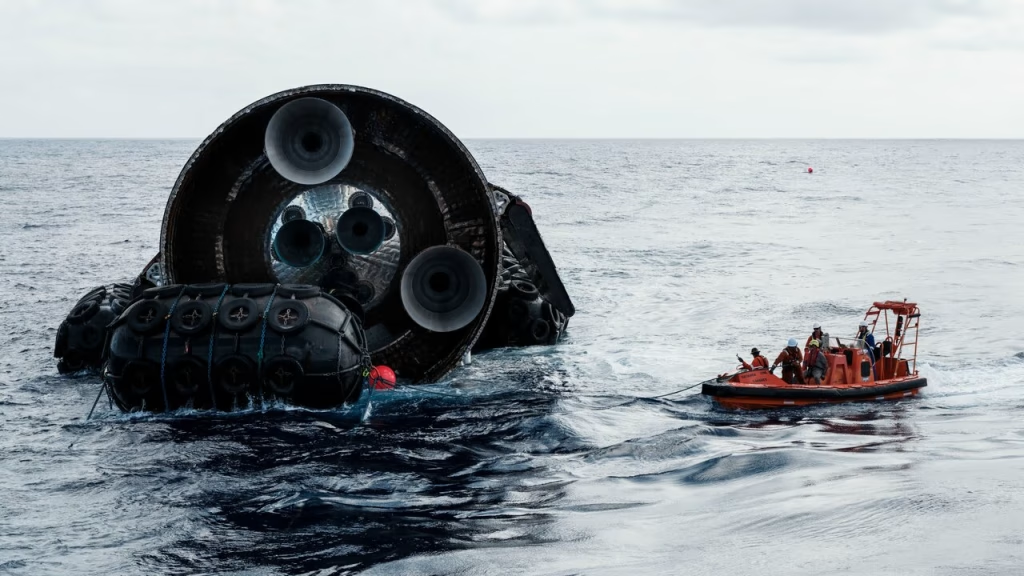
Recovery of the Starship from Flight 13 is facing increasingly difficult conditions in the Indian Ocean. Days after achieving the spacecraft’s most successful landing to date, the vehicle remains afloat as SpaceX teams try to tow it to the Australian coast.
In a post on X, SpaceX said its team continues working to bring the 52-meter-long (170-foot-long) Starship to port, despite “challenging conditions and increasingly rough seas.”
Elon Musk responded to the post with a warning: “Unfortunately, ship recovery is not looking good right now. However, we did get close-up photos of critical heat shield and engine areas for future upgrades.“
The SpaceX Recovery team is still working to recover Flight 13’s Starship from the Indian Ocean. They’ve been overcoming challenging conditions and increasingly rough seas as they attempt to guide the 52m long spacecraft to port pic.twitter.com/ECT5FyCvr7
— SpaceX (@SpaceX) August 7, 2026
Rough Seas Threaten Starship Recovery
The Starship is adrift more than 1,220 kilometers (760 miles) off the coast of Australia, while the 91-meter (299-foot) Normand Ranger attempts to tow it toward Dampier.
The operation is taking place under winds of about 48 km/h (30 mph) and waves up to 4 meters (13 feet) — unfavorable conditions for hauling a spacecraft that was never designed to function as a seafaring vessel.
The Normand Ranger is towing the Starship at roughly 3 knots (5.6 km/h), on a journey that could take two weeks or more. Should the vehicle start taking on water or suffer damage from strong winds and waves, crews could be forced to abandon it.
Satellite images also showed the Go Australis and Skimmer Tide operating near the Starship. The Go Australis has been tracking the spacecraft since it began drifting, covering more than 400 kilometers (250 miles) since splashdown.
Starship Survives Flight 13
Launched on July 24, 2026, Starship’s 13th test flight lifted off from Starbase in South Texas. Like previous missions, the flight was suborbital and involved both stages of the rocket, which followed separate trajectories after separation.
The Super Heavy, standing 72 meters (236 feet) tall, is the rocket’s first stage and handles the initial propulsion. It headed back toward the Gulf of Mexico but failed to complete a controlled landing, hitting the water hard instead. The second stage, the Ship, continued on its own and performed a controlled reentry before executing a soft landing in the Indian Ocean, off the coast of Western Australia.
When the Super Heavy is stacked with the Starship upper stage, the full assembly reaches roughly 124 meters (407 feet) in height.
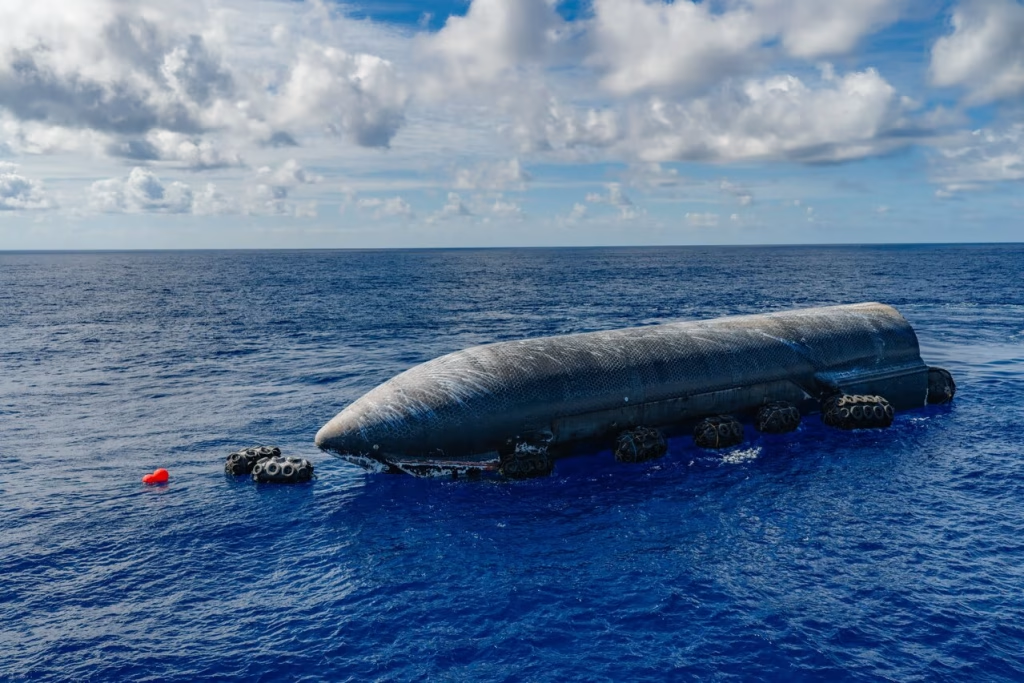
Unlike previous tests, in which the spacecraft either broke apart or sank quickly, the Ship survived reentry, remained intact, and stayed afloat after hitting the water.
The vehicle did tip over and became exposed to the waves, but it stayed intact enough to give SpaceX an unprecedented opportunity to examine the vehicle after a full-scale test flight.
Musk said he was “a little worried“ about Flight 13 because of its association with Apollo 13, the 1970 lunar mission that faced a major in-flight emergency. According to him, though, “the flight actually went incredibly well.”
Photos Reveal Valuable Data
Even if rough seas prevent the Starship from reaching port, the mission has already produced important information.
The Ship’s survival allowed engineers to directly examine parts of the spacecraft after subjecting it to the extreme conditions of a spaceflight, rather than relying solely on telemetry data or debris analysis.
Should recovery be completed, it would be even more significant: it would mark the first Starship ever recovered after a full-scale test flight.
Flight 13 Also Tested Starlink V3
During Flight 13, the upper stage deployed 20 functional Starlink V3 satellites for the first time — a larger, next-generation version of SpaceX’s broadband satellites.
Since the mission was suborbital, the goal wasn’t to place them into permanent orbit. After deployment, the team successfully established contact with all 20 Starlink V3 satellites via radio frequency and laser links, downloaded telemetry data, and validated the deployment mechanism.
The experiment served as a technology demonstration for the future expansion of the Starlink constellation. SpaceX plans to launch a fleet of roughly 100,000 Starlink V3 satellites via Starship.
A Step Toward Full Reusability
The Starship is the largest and most powerful rocket ever built, with a designed capacity to carry more than 100 metric tons to low Earth orbit. Its two stages — the Ship and the Super Heavy booster — were designed to be fully and rapidly reusable.
Flight 13 showed that the Ship can survive reentry and an ocean landing under controlled conditions. Now, the recovery attempt adds a new challenge: figuring out whether a Starship that survives the flight can also be hauled back to land and prepared for a future mission.
Even if rough seas prevent the recovery of the “lucky number 13,” the data collected, the Starlink V3 tests, and, above all, the detailed images of the heat shield and engines have already turned the flight into a valuable source of information for future generations of Starship.
Sources & References
- Ars Technica: Flight 13 analysis and next steps for Starship
- Elon Musk (X / Twitter): Statement on ship recovery status
- Express News: Report on Indian Ocean recovery operations
- Reuters: Coverage of the 13th test flight launch
- Scientific American: Technical details and rocket specifications
- Space.com: Information on Starlink expansion and plans
- SpaceX (X / Twitter): Official mission and recovery updates