How automation and Artificial Intelligence (AI) are transforming milk production and life in the countryside.
Introduction: The Shocking Fact of the New Livestock Industry
Imagine a dairy farm with 500 cows where, most of the time, the daily operations are handled by a single employee. This ratio, unthinkable in the traditional system, is the reality of the Van Adrichem family farm in Tasmania (Australia), initially pioneered by John van Adrichem.
The future of high-efficiency dairy farming has already arrived. The son, Arjan van Adrichem, led the implementation of a sophisticated system with eight robots to manage the herd, achieving this unprecedented efficiency. This groundbreaking work earned the family, in November 2025, the Innovation Award at the Cadbury Farmer of the Year Awards. This case study is a landmark: technology not only increases productivity but redefines the human role in agriculture.
The Case Study: 8 Robots for 500 Cows
Van Adrichem’s farm, located in a humid region with a strong dairy tradition, operates 24/7, based on autonomy and real-time data.
The Milking and Animal Welfare Revolution
Instead of fixed schedules and intensive labor, the system uses eight milking robots. The main curiosity is that each cow decides when it will be milked, according to its own physiological rhythm.
Upon entering the station, the robot is not just a mechanical arm; it is a hygienist and a precision technician.
• Cleaning and Hygiene: The robot cleans the teats/udder automatically, using sanitary brushes to remove dirt and debris — essential for udder health and milk quality.
• Precision Connection: The system features automatic detection of teat position through laser scanning and camera technology, enabling the robotic arm to attach the teat cups automatically and accurately.
• Automated Processes: The system includes automatic milk filtration and automatic filter changes, further reducing the need for human intervention and ensuring continuous, hygienic operation.
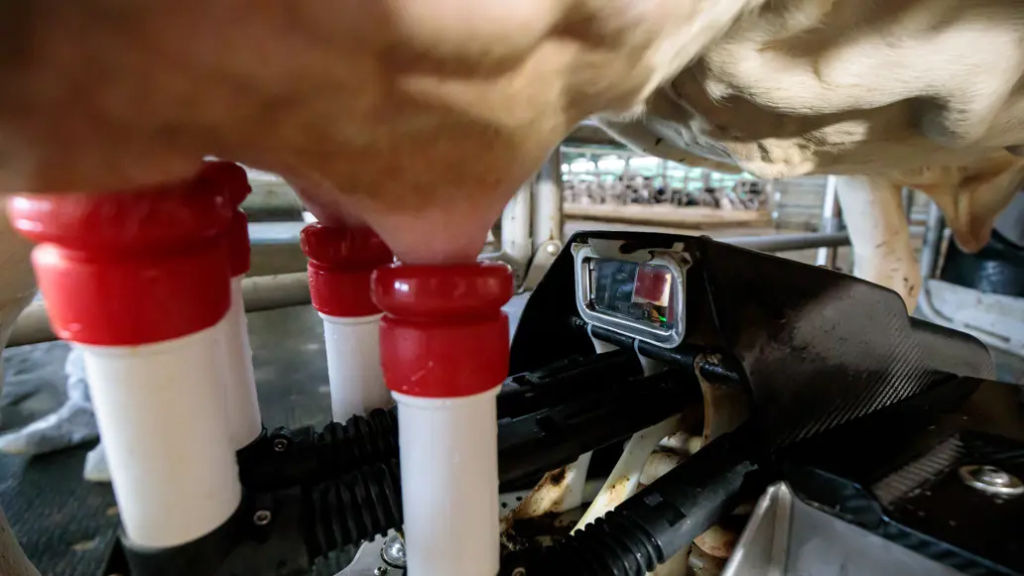
The entire process is recorded in real time in a centralized herd-management platform.
The Worker: From Milker to Data Manager
The impact on labor efficiency is striking. While the Australian average requires one worker per 120 cows, the Togari system manages around 500 cows with just one employee for most of the year.
The role of this single worker is completely transformed. He no longer performs manual milking but acts as a supervisor of a highly automated system. His focus is on monitoring digital indicators, responding to alerts from the robots, and adjusting feed and pasture management as needed.
Additional personnel are required only during spring calving, when animal handling demands more human presence.
📈 The Secret: Precision Dairy Farming
Automation goes far beyond milking, functioning as a continuous and comprehensive clinical assessment of the herd. This is the essence of Precision Dairy Farming.
• Continuous Diagnostics: The robots constantly analyze data such as feed intake, weight, and movement patterns. Any drop in production or change in behavior triggers a software alert.
• Early Interventions: This allows producers to detect health or fertility issues early, reducing treatment costs and preventing losses.
• Cost Control and Sustainability: By minimizing waste of veterinary supplies and feed, the system maintains strict cost control and improves sustainability.
Sustainability: Protecting Soil and Feed
Efficiency and sustainability also guide the farm’s feeding system. Instead of relying solely on open pastures in a humid climate, the farm uses covered feeding platforms.
This structure ensures:
- Zero waste of silage and concentrate, protecting the feed from rain and mud.
- Prevention of soil damage caused by tractors operating on wet ground — crucial for long-term environmental sustainability.
These improvements were essential to Van Adrichem’s recognition in the Innovation Award.
🔮 The Future of Work and Agribusiness
Van Adrichem’s farm demonstrates that automation is the key to dealing with rising costs and labor shortages in the dairy industry.
While technology reduces the need for full-time workers, it creates demand for a new professional profile: the rural worker must evolve into a technology and data-analysis specialist.
This trend extends beyond milking. The dairy sector is also advancing through initiatives such as Cadbury’s US$200,000 program to help producers measure and reduce carbon emissions, boosting profitability and sustainability.
Farm 4.0 is no longer a promise — it is the present reality of a more efficient, intelligent, and human-centered food production system.