Light and Porcelain in the Depths: Two New Species Unveil Secrets of Australia’s Seas
In a compelling demonstration that the ocean’s depths remain Earth’s last unexplored frontier, scientists have announced the description of two remarkable new marine species. Collected during a 2022 expedition aboard the research vessel RV Investigator, the specimens — a bioluminescent Lanternshark and a delicate Porcelain Crab — were formally described by independent researchers, revealing secrets hidden in the waters off Western Australia.
The expedition took place in 2022, but the official announcement of the discovery of these two species was made only on October 6, 2025, after a rigorous analysis and description process.
The expedition, led by CSIRO (Australia’s national science agency) and conducted for Parks Australia, explored the biodiversity of the Gascoyne Marine Park. The discoveries serve as a reminder of how little is still known about these deep-water ecosystems.
The Shark That Glows in the Abyss
The first and perhaps most fascinating discovery is a new shark species, officially named the Western Australian Lanternshark (Etmopterus westraliensis). This remarkable creature was found at depths reaching 610 meters, a world of near-total darkness.
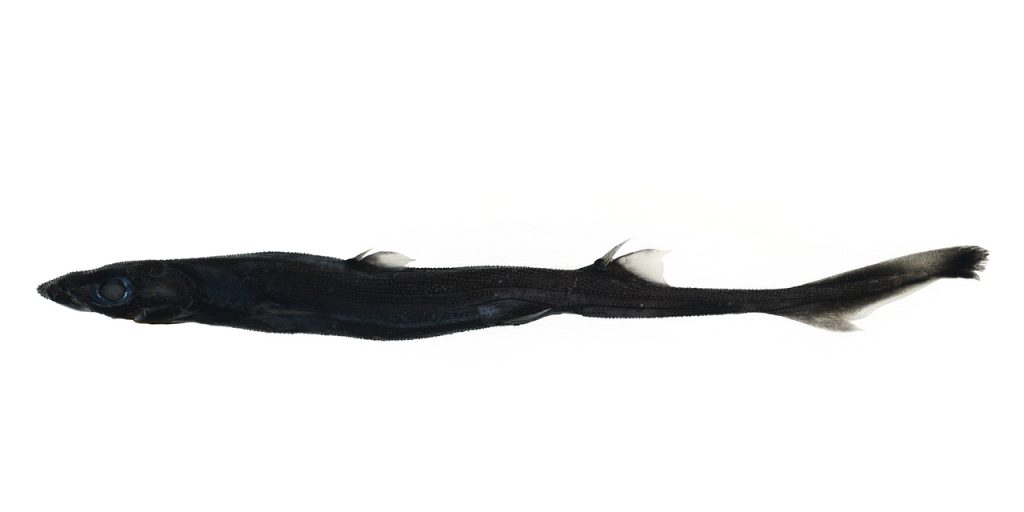
E. westraliensis is a small shark, measuring around 40 centimeters long — slightly bigger than a forearm. It has a slender body and notably large eyes — perfect adaptations for seeing in an environment with extremely low light. Its dorsal fins are equipped with a sharp spine, a crucial defensive feature. Six lanternshark specimens were collected during the expedition to enable its scientific description.
The Luminous Survival Trick
What truly sets it apart is its ability to glow in the dark. According to Dr. Will White, a CSIRO ichthyologist, the lanternshark is bioluminescent.
“The light is produced by photophores located on its belly and flanks, which explains its common name,” Dr. White said.
This bioluminescence is more than just a spectacle — it is a survival mechanism. Scientists believe the light helps the shark camouflage itself through counter-illumination, essentially erasing its silhouette against the faint residual light that may filter from above, hiding it from predators and allowing it to sneak up on prey.
The discovery of E. westraliensis, which references Western Australia, joins two other new shark species described from the same 2022 expedition: the Painted Lanternshark and the Crested Egg Catshark, reinforcing the biological richness of the region.
The Delicate Porcelain Crab
The second discovery is completely different in shape and function. The new Porcelain Crab (Porcellanella brevidentata) was found in shallower waters, around 122 meters deep, off Ningaloo.
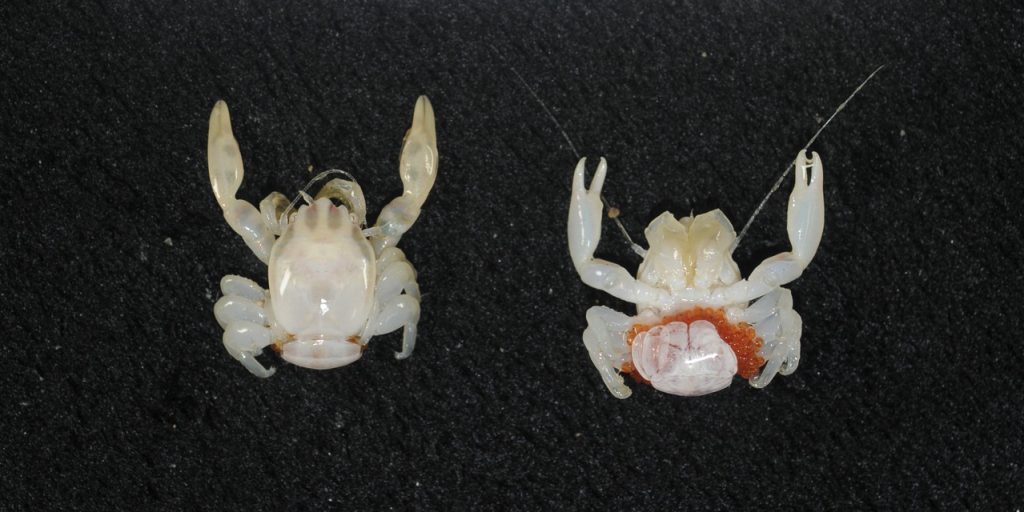
Its description was carried out by Dr. Andrew Hosie, curator of Aquatic Zoology at the Western Australian Museum. The name “porcelain” reflects its appearance: the crab is tiny, measuring only 1.5 centimeters (15 millimeters), and displays an opalescent white-yellow coloration.
Symbiotic Life and Fine Filtration
What makes this crab particularly interesting is its lifestyle and feeding habits.
• Symbiotic Camouflage: “The new species lives a symbiotic life with sea pens,” Dr. Hosie explained, “where they hide among the ‘leaves’ of the host.” Its pale coloration makes it almost invisible among the soft, white folds of the soft coral.
• Filter Feeding: Unlike typical crabs that use claws to grab and pinch, porcelain crabs are filter feeders. They consume plankton using modified mouthparts with long setae that sift the water for small food particles.
The crab also has distinctive markings around its eyes, which served as crucial identifiers to differentiate it from other known porcelain crab species.
The Tip of the Iceberg
The two newly described species were among more than 20 potential new organisms documented during the expedition that explored the biodiversity of the Gascoyne Marine Park.
The discoveries, published in scientific journals such as Ecology and Evolution, underscore the vital importance of continuing biodiversity surveys in deep waters. Researchers are already planning future missions to other marine parks, hoping to bring to light more stories of survival and adaptation from the creatures that call the ocean floor their home.