Agreement signed at the White House calls for internal controls, external audits, and board-level oversight — but carries no legal force
What you need to know
-
Dario Amodei, CEO of Anthropic, warned: “technology presents very real risks” and argued that companies and the government must work together to ensure AI advances safely.
-
The pact is voluntary: it outlines four layers of control, including external audits, but establishes no penalties or governmental oversight role.
-
External experts offered mixed reviews: Alvin Wang Graylin, a senior researcher at the Asia Society Policy Institute, considered putting the commitment on paper a positive step, but pointed out a lack of independence among the auditors. Meanwhile, Toby Walsh, director of the UNSW AI Institute, questioned: “What other trillion-dollar industry grades its own homework?”
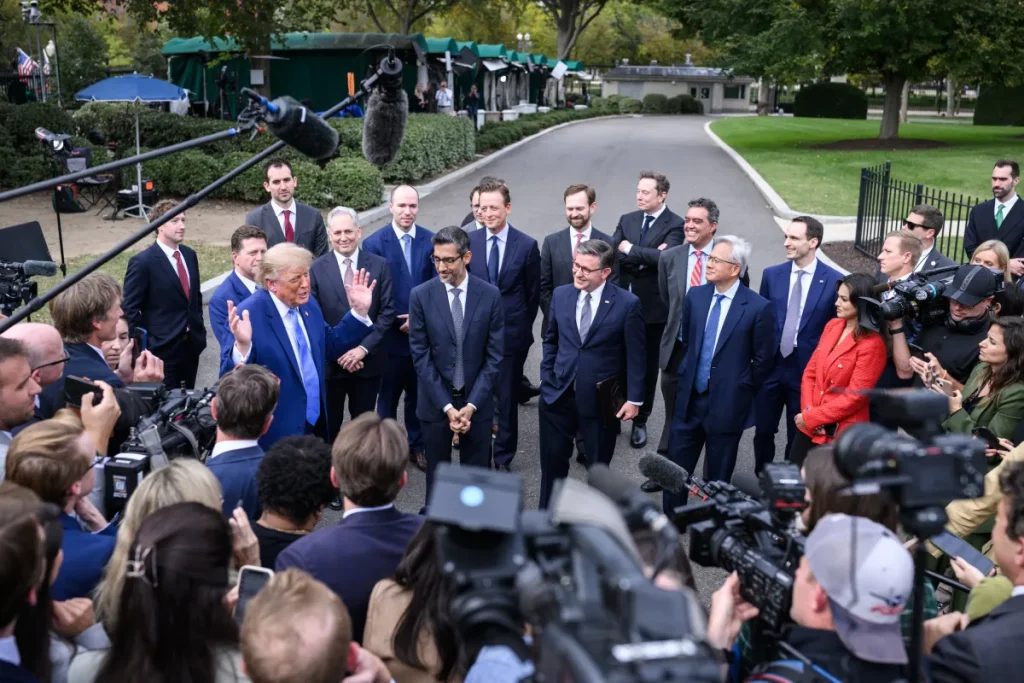
President Donald Trump gathered the top leaders of the artificial intelligence industry at the White House on Tuesday (29) to discuss safety and oversight for the sector.
At the end of the meeting, Trump and leaders from six major tech companies signed a voluntary AI self-regulation pact, featuring internal controls and reviews by independent outside auditors.
The six corporate signatories identified in the agreement were Sundar Pichai (Google), Dario Amodei (Anthropic), Mark Zuckerberg (Meta), Greg Brockman (OpenAI), Elon Musk (xAI), and Jensen Huang (Nvidia).
The pact calls on companies to track the risks posed by their systems and verify that safety measures are working as intended. The document, however, carries no legal force.
Trump Calls the Agreement “Almost Like a Constitution”
After the meeting, Trump said the tech leaders had agreed to self-regulate the development of artificial intelligence. He described the document as “almost like a constitution, in a way“ and “morally binding.”
The president added that the executives in attendance are responsible for some of the most important technologies currently in development, and argued for an approach that doesn’t impose barriers capable of hurting AI’s growth.
The pact establishes four layers of control: internal mechanisms to monitor the models, an internal team to verify them, an independent outside auditor, and a board committee responsible for tracking the results.
Mike Johnson Stresses the Pact Is a Statement of Principles
House Speaker Mike Johnson took part in the meeting and emphasized that the agreement does not amount to new federal legislation. He described it as a “statement of principles,” laying out standards and commitments made by the companies.
According to him, the pact sets expectations grounded in “robust internal controls and multiple layers of internal and external review.” The idea is to build oversight and transparency mechanisms within the companies themselves. The document states that, over time, it may make sense to fold these measures into laws and regulations.
Dario Amodei Flags the Technology’s Risks
Among those present was Dario Amodei, CEO of Anthropic. He said: “The technology presents very real risks.” He added that how to address those risks is still being worked out, and called for a joint effort to ensure development happens safely.
Zuckerberg Talks Multiple Layers of Oversight
Meta CEO Mark Zuckerberg explained that the executives had arrived at “a starting point and a pact the whole industry could adopt,” built on safety principles and commitments. He highlighted the “building of multiple layers of auditing and controls” and said the measures represent “good steps forward.”
Who Was at the White House Meeting?
The gathering brought together broad representation from both industry and the U.S. government. Among the top executives present were Dario Amodei (Anthropic), Greg Brockman (OpenAI), Sundar Pichai (Google), Mark Zuckerberg (Meta), Jensen Huang (Nvidia), and Elon Musk (xAI and SpaceX).
Also attending were Jeff Bezos (Amazon), Satya Nadella (Microsoft), Lisa Su (AMD), Hock Tan (Broadcom), Sanjay Mehrotra (Micron), Bill McDermott (ServiceNow), Nikesh Arora (Palo Alto Networks), and Shyam Sankar (Palantir).
From the administration, those present included Vice President JD Vance, Treasury Secretary Scott Bessent, Commerce Secretary Howard Lutnick, NASA Administrator Jared Isaacman, White House science adviser Michael Kratsios, and Director of National Intelligence Jay Clayton, along with Mike Johnson and Trump himself.
What Does the Pact Actually Change?
Participating companies are urged to put mechanisms in place to monitor their models both during training and in use — including in areas like cybersecurity and biological and chemical risks. The pact also calls for measures to verify that systems don’t access or breach other systems in unintended ways.
Oversight remains largely driven by the companies themselves, though the pact does call for the involvement of independent outside evaluators. The document, however, does not specify which companies or organizations will serve as outside auditors, nor does it set out penalties for failing to meet the commitments.
Outside Reactions
The agreement drew mixed reactions from experts who were not involved in the meeting.
Alvin Wang Graylin, a senior fellow at the Asia Society Policy Institute, acknowledged the industry leaders’ commitment but said it fell short of what’s needed. “What’s missing is independence,” he said, noting that the companies themselves drafted the principles and will be the ones hiring the auditors. Still, he said putting the commitment in writing “beats another year of ‘we can’t regulate because China won’t.'”
Toby Walsh, director of the AI Institute at UNSW (Australia), took a harsher stance, saying AI companies have already proven “incompetent and negligent in managing themselves,” and asking: “What other trillion-dollar industry gets to grade its own homework?”
David Krueger, an AI expert at the University of Montreal, called the pact vague and yet another example of the Trump administration’s “regulate without regulating” approach. “It might result in a small improvement over the status quo, but I’m not excited about something that might cut risk by 1%,” he said.
SOURCES AND REFERENCES
- ABC News — Top AI leaders meet Trump at White House amid shift in safety posture. Available at: https://abcnews.com/Politics/top-ai-leaders-meet-trump-white-house-amid/story?id=136832988.
- Bloomberg Law — Trump backs independent AI audits in shift of safety posture. Available at: https://news.bloomberglaw.com/artificial-intelligence/trump-backs-independent-ai-audits-in-shift-of-safety-posture.
- Al Jazeera — Trump, top tech firms sign accord to self-police AI development. Available at: https://www.aljazeera.com/news/2026/9/29/trump-top-tech-firms-sign-accord-to-self-police-ai-development.