While the world debates digital infrastructure for artificial intelligence, the Asian country is already running submerged servers, cooled by seawater and, in Shanghai, powered directly by an offshore wind farm.
🔍What you need to know
- Commercial breakthrough: China has scaled to a commercial level an idea Microsoft first piloted with Project Natick, currently operating underwater data centers that leverage seawater to cool servers.
- Energy and sustainability: subsea cooling cuts overall electricity consumption by 22.8%, reduces land use by over 90%, and eliminates the need for fresh water in cooling operations. In the Lingang project (Shanghai), the system is supplemented by electricity sourced directly from an offshore wind farm.
- Challenges ahead: despite initial positive results, questions remain regarding equipment durability, seawater corrosion, and potential impacts on marine ecosystems.
Microsoft was one of the first companies to test the idea. In 2018, it launched Project Natick in Scotland’s Orkney Islands, and in 2020, reported promising results. Despite the results, the project never moved forward into large-scale commercial deployment.
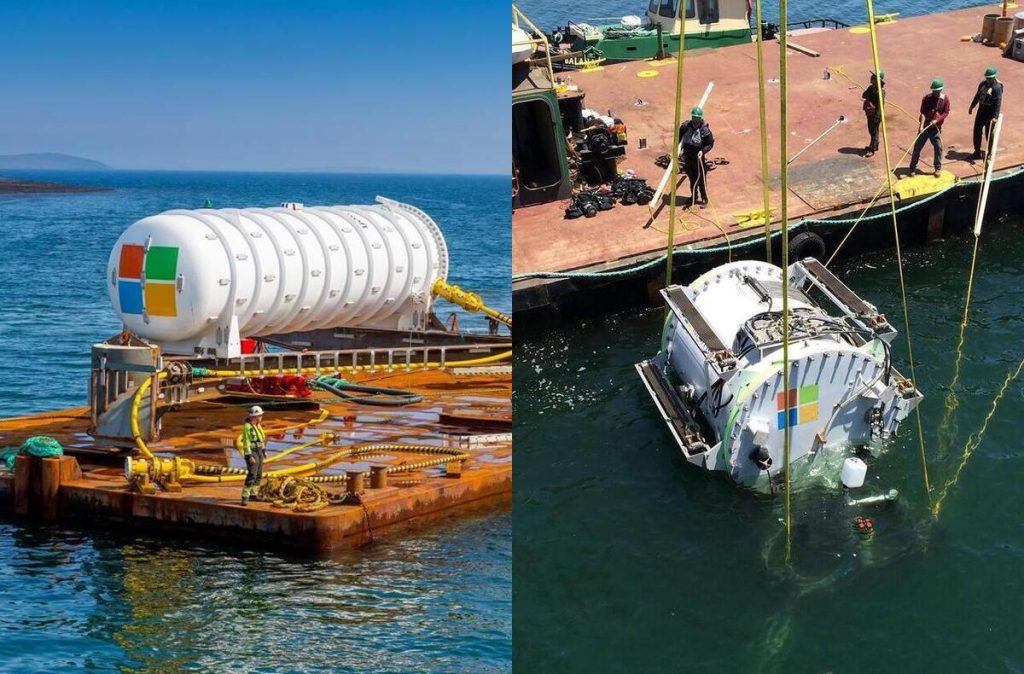
China, meanwhile, turned the concept into commercial reality. According to Dr. Hanjiang Dong of the Hong Kong Polytechnic University: “Microsoft proved the concept; China moved faster on implementation because it brought together market demand, industrial capacity, naval engineering, and political support more quickly.”
Two Projects, Two Milestones
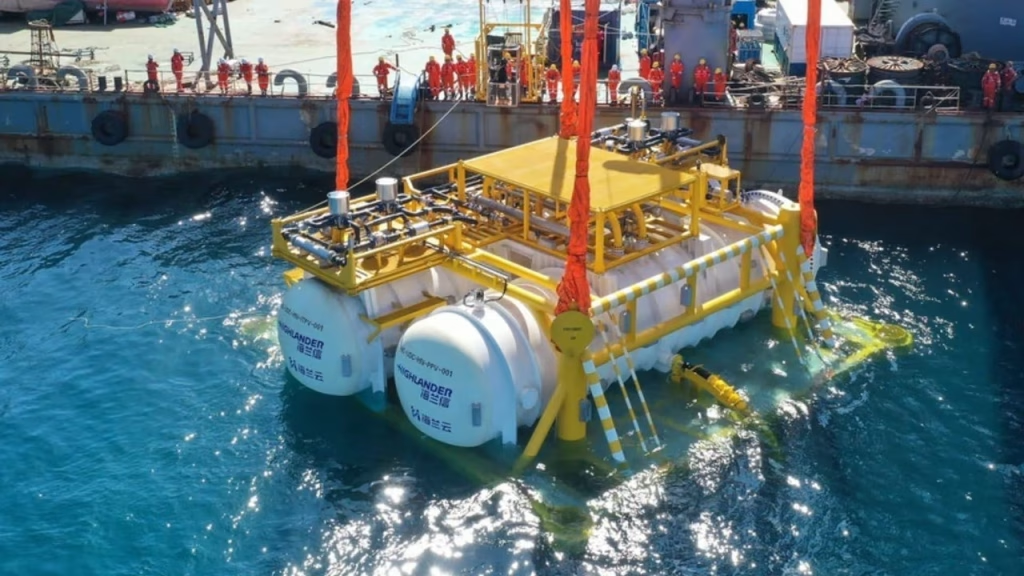
In 2023, HiCloud Technology opened the world’s first commercial underwater data center in Lingshui, on Hainan Island. Capsule-shaped modules have been operating at a depth of roughly 115 feet (35 meters) since late 2022.
According to China’s Xinhua news agency, the cluster already exceeds 675 PFlops of computing power — the equivalent of 30,000 high-performance gaming PCs working together — and runs stably, with no server failures and no on-site maintenance.
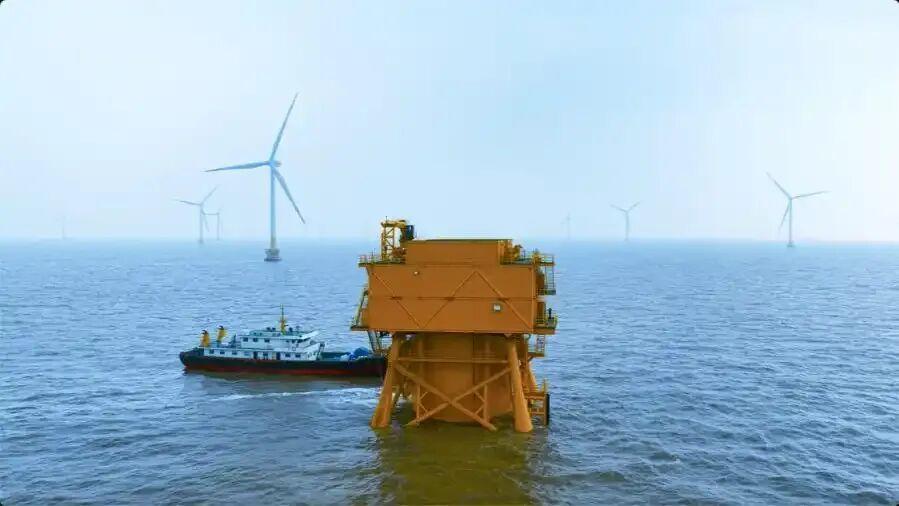
The next leap came in Shanghai. The Lingang data center, launched in June 2025, is the world’s first powered by an offshore wind farm. The project has a planned capacity of 24 megawatts and resulted from a partnership between HiCloud Technology and Chinese state-owned companies, with an investment of 1.6 billion yuan (roughly $226 million).
The facility sits about 6 miles (10 km) off the coast of Lingang, in Shanghai, and is submerged 33 feet (10 meters) below the surface.
Real Advantages
The key difference lies in natural cooling from seawater. In traditional data centers, cooling accounts for about 40% to 50% of total energy consumption. In Shanghai’s underwater project, that figure drops to under 10%, according to Wired.
The result is a 22.8% cut in total electricity consumption, along with a reduction of more than 90% in land use and the complete elimination of freshwater use for cooling. More than 95% of Lingang’s electricity is estimated to come from green sources, including the offshore wind turbines.
In Hainan, the numbers were already striking: at full capacity, the facility saves 26,000 tons of fresh water and 3.4 million kWh per year, avoiding roughly 2,720 tons of carbon emissions — equivalent to planting nearly 150,000 trees.
If Hainan showed that the ocean could solve part of the cooling problem, Shanghai added a second piece to the equation: beyond natural seawater cooling, the project now draws most of its electricity directly from the offshore wind farm.
How It Works in Practice
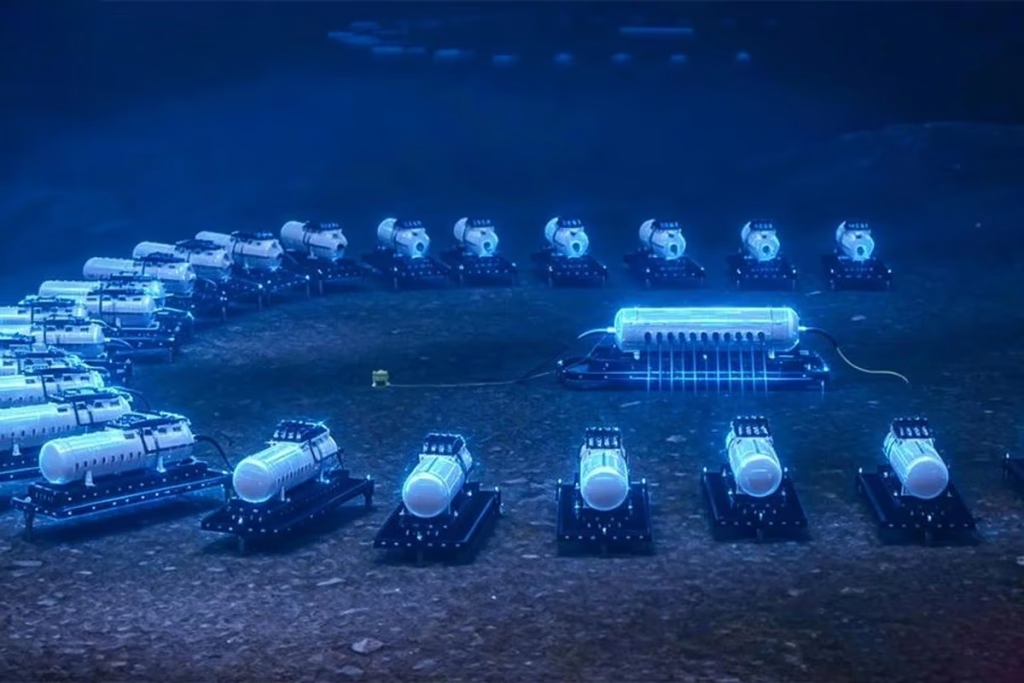
The servers sit inside hermetically sealed modules. Seawater circulates through heat-exchange systems, providing continuous, natural cooling.
In Hainan, day-to-day operations can be managed remotely from land, with fewer than ten staff members at the support station. The system has run stably for nearly three years, reducing the need for on-site inspections.
Beyond energy efficiency, the project taps into existing international undersea cable connections and could help anchor an industrial ecosystem built around artificial intelligence, 5G, the Internet of Things, and cross-border e-commerce.
What’s Still Unknown
Despite the encouraging early results, commercial-scale underwater computing remains largely uncharted territory. No one knows exactly how these systems will hold up after decades of pressure and corrosion from seawater.
There are also environmental concerns: the continuous release of heat and possible sediment disturbance could affect marine ecosystems. Experts consider the risks manageable but stress the need for ongoing monitoring.
A Real-World Lab for the Future of Computing
While tech companies are already discussing data centers in space, China’s projects function as real-world labs. They’re testing whether shifting computing infrastructure into the ocean can solve land-based problems — or whether it will reveal entirely new ones.
With demand for computing capacity expanding rapidly and 90% of AI-specialized data centers concentrated in China and the United States, the bet on servers beneath the waves, powered by wind and cooled by the sea, marks an important chapter in the search for more sustainable digital infrastructure. Time will tell whether the solution is here to stay.
Sources & References
- Microsoft News: A Microsoft considera datacenters subaquáticos confiáveis, práticos e que usam energia de forma sustentável — news.microsoft.com
- The Guardian: World’s first wind-powered underwater datacentre starts operating in China — theguardian.com
- DatacenterDynamics: China’s HiCloud reports commercial underwater data center modules are working — datacenterdynamics.com
- Xinhua Net (English): China underwater data center coverage report — news.cn
- Wired: China opens world’s first wind-powered underwater data center — wired.com
- People’s Daily Online: China’s underwater computing infrastructure developments — people.cn