CEO Julie Sweet asks staff for extra effort in the final stretch of the fiscal year, following a stock drop and pressure to close new deals
🔍 WHAT YOU NEED TO KNOW
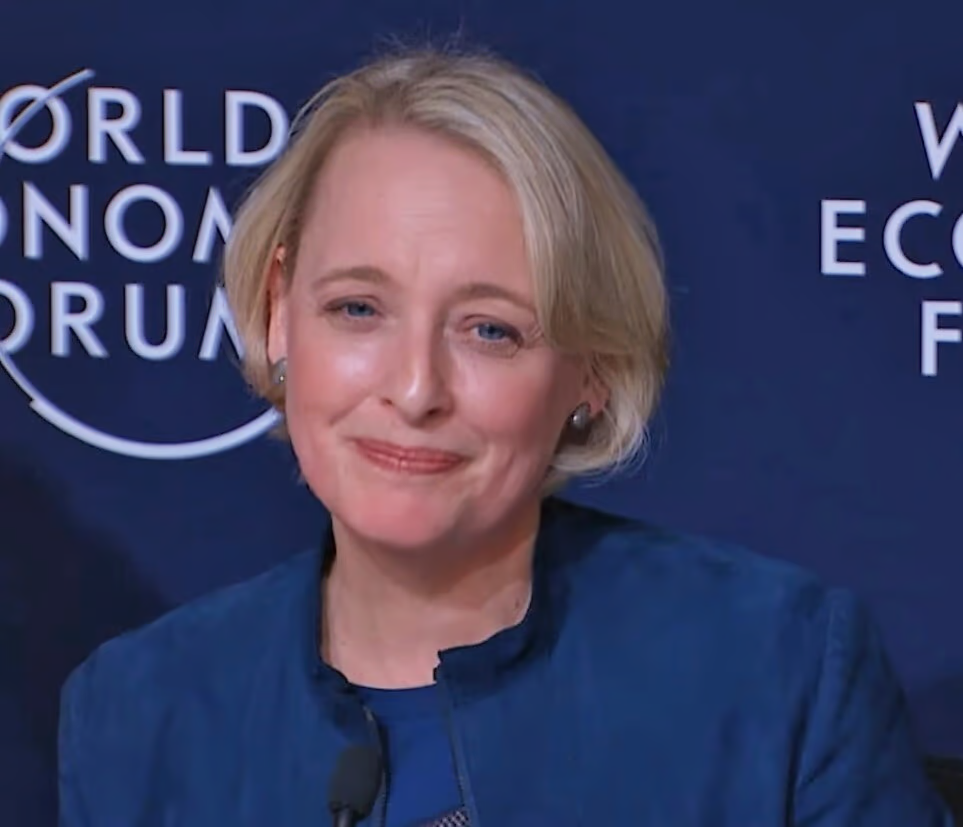
- Pressure for results: Accenture CEO Julie Sweet asked nearly 800,000 employees to consider postponing their August vacations to help close new deals before the company’s fiscal year ends this month.
- Historic stock drop: The pressure mounted after the company reported a 2% drop in new bookings and saw its stock plunge roughly 18% in a single day in June.
- The artificial intelligence paradox: The consulting and tech giant is trying to prove that demand for AI projects generates more revenue than automation displaces in its traditional lines of work.
Accenture CEO Julie Sweet made an unusual request to employees: to consider postponing their vacations until after the end of August. The reason lies in the company’s financial calendar — August marks the close of the fiscal year, and the company is racing against the clock to close more deals before the books close.
So What Does Accenture Actually Do?
Accenture is one of the world’s largest consulting and technology services firms, helping major companies and governments implement solutions in artificial intelligence, cloud computing, cybersecurity, and enterprise systems.
Rather than selling a ready-made product, the company is typically hired to execute projects, train employees, and modernize operations for clients across sectors such as banking, healthcare, manufacturing, and government.
With 799,000 employees in more than 120 countries and roughly 9,000 clients, the company runs a massive, truly global operation.
Why the Calendar Matters So Much
Unlike the standard calendar year, Accenture’s fiscal year runs from September 1 to August 31, split into four quarters — with the final one covering June, July, and August. That makes August the company’s last chance to close deals that still count toward this year’s results.
In an internal memo obtained by Bloomberg, Sweet stressed that shareholders are expecting a strong quarter. “Our shareholders are counting on us to deliver a strong Q4 — everyone can contribute,” the CEO wrote.
As an incentive, the company is allowing employees to carry over unused vacation days into the next fiscal year, which begins September 1. Accenture typically requires employees to use their remaining vacation days before the fiscal year ends. This one-time change removes the “use it or lose it” pressure and helps keep more people available during the final stretch.
The Numbers Behind the Pressure
The decision didn’t come out of nowhere — it follows Accenture posting weaker-than-expected results. New bookings (contracts signed for future work) fell 2% in the quarter ended May 31.
The fallout was immediate: after the results were released in June, Accenture’s stock plunged roughly 18% in a single day, one of the biggest one-day drops in the company’s history.
For the fourth quarter, the company projected revenue between $17.75 billion and $18.4 billion — below the average analyst estimate of $18.47 billion.
Accenture’s Complicated Relationship With AI
There’s a particularly interesting wrinkle behind this scramble: the same technology that could boost Accenture also threatens part of its traditional business model.
On one hand, AI is an opportunity — many organizations need help implementing it, adapting systems, and training staff, work that generates contracts precisely for consultancies like Accenture. On the other hand, AI itself can already handle tasks that once required large teams of professionals, such as research, analysis, and programming.
Bloomberg Intelligence sums up the dilemma well: AI remains a central concern for the consulting sector, but so far there’s little concrete evidence that the technology is actually accelerating demand for these services.
The Real Challenge Behind the Request
In the end, Sweet’s appeal doesn’t signal a crisis. It reveals, instead, leadership’s big bet for these final weeks: proving that demand for AI-related services will generate more growth than the traditional work the technology itself is automating.
For now, Accenture is betting on people — not algorithms — to win this race against the calendar. What remains to be seen is whether, in the next fiscal year, the company will still need to ask its nearly 800,000 employees for this kind of sacrifice.
Cover photo: Accenture office at PCT Cartuja in Seville, Spain. Photo by Zarateman / CC0 1.0