Uber has just taken a bold step toward the future of transportation. The company announced a $300 million investment in Lucid Motors, the luxury electric vehicle manufacturer, to produce a new fleet of fully autonomous robotaxis.
Partnership with Lucid and Nuro
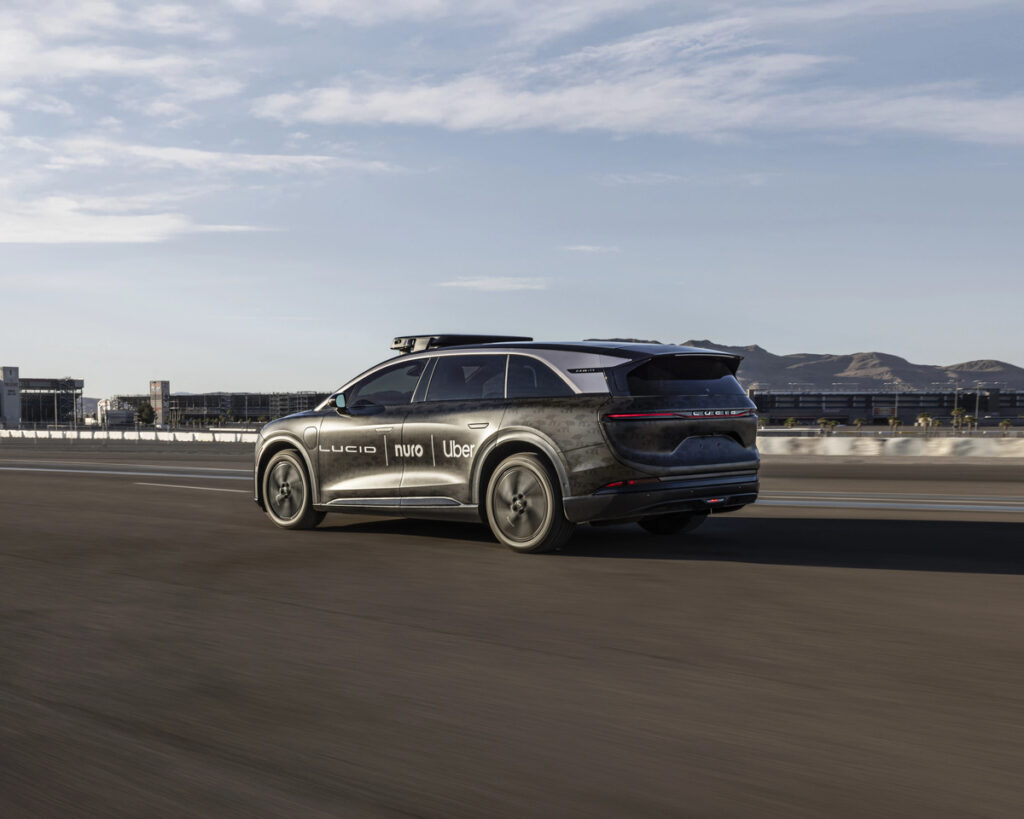
The project will be carried out in collaboration with two companies: Lucid, which will provide the vehicles, and Nuro, a startup specializing in autonomous driving. The goal is to deploy over 20,000 Lucid Gravity electric SUVs equipped with self-driving technology by 2031.
The first robotaxis are expected to hit the roads in 2026 in a major U.S. city—yet to be disclosed.
This marks Uber’s renewed push into the robotaxi market after its exit from the sector in 2020.
The agreement with Lucid follows Uber’s robotaxi deal in April with Volkswagen, which will supply its ID.Buzz vans for a planned commercial service in Los Angeles next year. Dave Ferguson, Nuro’s co-founder, emphasized that this deal is “by far the largest Uber has ever made” in the autonomous vehicle sector. He believes this partnership could bring self-driving car technology to a much broader audience.
Lucid had already designed its SUV to support advanced technologies, which made it easier to integrate Nuro’s sensors and systems.
Level 4 Autonomous Technology
The vehicles will be equipped with Nuro’s Level 4 autonomous driving system. This technology enables the car to drive itself in most scenarios without human intervention, although it still faces limitations in unstructured environments.
A prototype is already being tested in Las Vegas, operating autonomously within a closed circuit.
Exclusive Luxury Service
Lucid’s robotaxis will be available exclusively through the Uber app and will have a premium positioning, similar to Uber Black.
The selected model for the fleet is the Lucid Gravity, a luxury electric SUV expected to deliver a more comfortable and sophisticated travel experience.
Uber aims to leverage its vast user base and global presence to popularize robotaxis and accelerate the adoption of this new technology.
The service will target users willing to pay more for innovation and exclusivity, given Lucid’s premium status. For reference, the Lucid Gravity starts at $79,900.
With this initiative, Uber seeks to expand its autonomous transportation offering, reinforcing its presence in the premium and tech-driven mobility sector.
Why It Matters
The autonomous vehicle industry has faced major challenges in recent years. High development costs, strict regulations, and technical limitations have slowed the rollout of self-driving cars.
Even so, Uber’s new investment sends a strong signal of confidence in the future of robotaxis.
Roadblocks Ahead
Despite the excitement, the path forward is still uncertain. The service will require state-level permits, and the companies will have to ensure operational safety in complex urban environments. Additionally, the electric vehicle market continues to face difficulties, with high costs and fluctuating demand.
Still, Uber’s bet is clear: to use its global scale to speed up the adoption of autonomous vehicles, offering a more sustainable, efficient, and tech-forward service to its users.
Project Summary
- Uber to invest $300 million in Lucid to produce robotaxis
- More than 20,000 autonomous Lucid Gravity SUVs to launch by 2031
- Service starts in 2026 in a U.S. city yet to be announced
- Level 4 autonomous technology to be provided by Nuro
- Prototype already in testing in Las Vegas
- Robotaxis will be exclusive to the Uber app, positioned as a premium service
- Despite ongoing market challenges, Uber doubles down on autonomous vehicles