Older than the pyramids of Egypt: stone structure over 120 meters long may have been built by hunter-gatherers on dry land
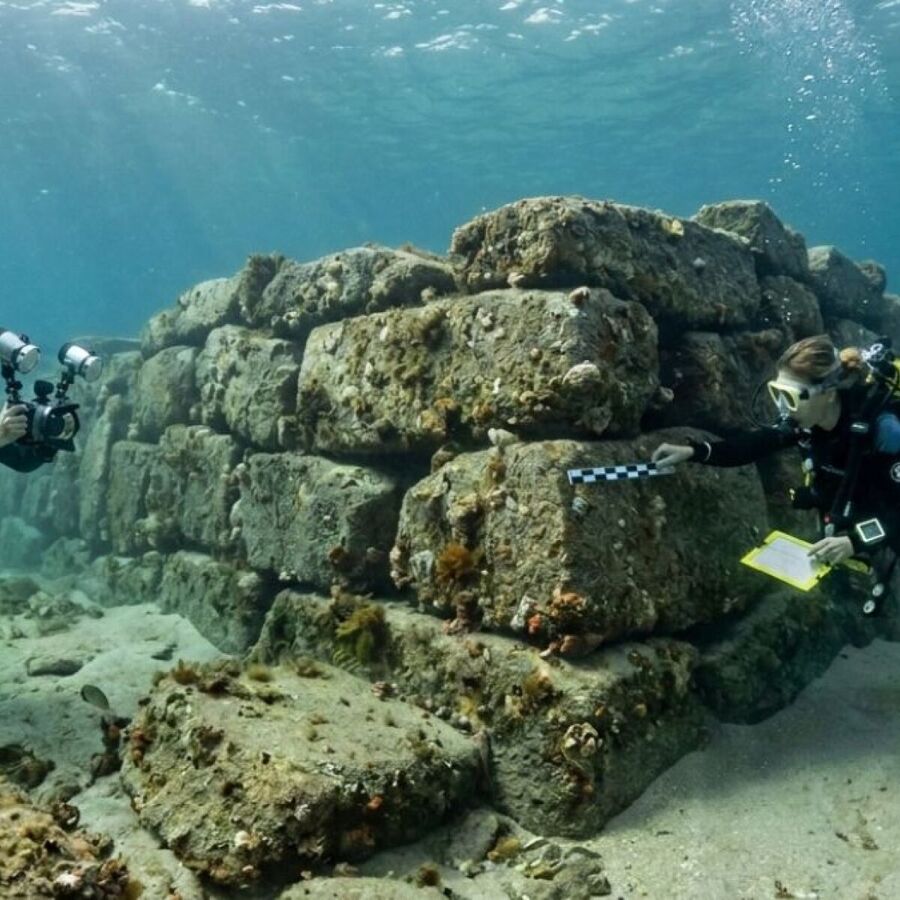
An impressive discovery on the west coast of France is drawing the attention of archaeologists around the world. A stone wall approximately 7,000 years old has been found submerged in the Atlantic Ocean, near the island of Sein, in the Brittany region — and it may change what we know about the earliest organized human societies along Europe’s coast.
A Monumental Structure Hidden Beneath the Ocean
The structure was located at a depth of about 9 meters (30 feet), but it was not always fully submerged. When it was built, between 5800 and 5300 B.C., sea levels were approximately 7 meters lower, a figure considered a regional average.
In addition, changes in the landscape over millennia, such as erosion and sediment accumulation, significantly altered the terrain. Archaeologists indicate that the wall was situated in a zone between low and high tide, meaning it could have been exposed during certain periods.
At that time, the island was up to 14 times larger than it is today, reinforcing the idea that the now-submerged area was once habitable and strategically important for human communities.
The wall is striking in its dimensions: about 120 meters (394 feet) long, 20 meters (65 feet) wide at its base, and approximately 2 meters (6.5 feet) high. Its structure is composed of large multi-ton monoliths and precisely fitted granite slabs, demonstrating a high level of planning and execution.
The discovery was detailed in a study published in the International Journal of Nautical Archaeology, highlighting its scientific significance.
Discovery Began with Laser Technology
Everything began in 2017, when retired geologist Yves Fouquet identified an unusual anomaly in seabed maps generated using laser scanning technology.
Years later, between 2022 and 2024, divers explored the site and confirmed the presence not only of the wall but also of a dozen other man-made granite structures, all from the same period.
Despite extremely challenging conditions — including strong currents, powerful waves, and dense marine vegetation — the structures remain remarkably well preserved.
What Was the Mysterious Wall Used For?
There is still no consensus on the exact function of the structure, but researchers are working with two main hypotheses:
- Fish traps: coastal structures used to capture fish during low tide
- Protection from the sea: containment walls to defend communities from flooding and rising waters
Interestingly, some of the walls discovered are too large for simple fish traps, suggesting an additional environmental protection role.
An Impressive Feat of Prehistoric Engineering
Regardless of its function, what intrigues experts most is the complexity of the construction. In an interview with AFP, archaeologist Yvan Pailler, from the University of Western Brittany, described it as:
“A very interesting discovery that opens up new prospects for underwater archaeology.”
The structures indicate that organized groups were capable of extracting, transporting, and assembling multi-ton stone blocks, requiring social coordination and advanced technical knowledge — comparable to the region’s famous megalithic monuments, but possibly predating them by several centuries.
A Window into a Key Transition in Human History
This period coincides with a crucial moment in history: the transition from the Mesolithic to the Neolithic, when hunter-gatherers began settling and developing agricultural practices.
The presence of such robust structures suggests the region offered abundant resources, such as fish, capable of sustaining a significant and organized population.
Between Science and Legend: The Possible Origin of the City of Ys
Beyond its historical value, the discovery may also be linked to ancient Breton legends. One of the most famous is the City of Ys, a mythical submerged city believed to have disappeared beneath the sea.
According to local accounts, this city would have been located near the island of Sein, in the Bay of Douarnenez — exactly where the structures were found. While unconfirmed, the discovery revives debate about possible real inspirations behind these stories.
A Submerged Past Still Full of Mysteries
With no preserved organic material, scientists were unable to use radiocarbon dating. Instead, the age was estimated based on reconstructed historical sea levels and known patterns of human occupation in the region.
Even with many unanswered questions, one thing is certain:
these structures reveal a surprisingly advanced level of social organization and engineering at a much earlier time than previously believed.
And as the ocean continues to guard its secrets, this discovery shows that a significant part of human history may still lie hidden beneath the waters — waiting to be uncovered.
For more information: Check out the original documents of this discovery in the Polymathique Report and the International Journal of Nautical Archaeology.