The Accelerating Rift: What the 56-Kilometer (35-Mile) Crack in the Afar Desert Reveals About the Continent’s Geology
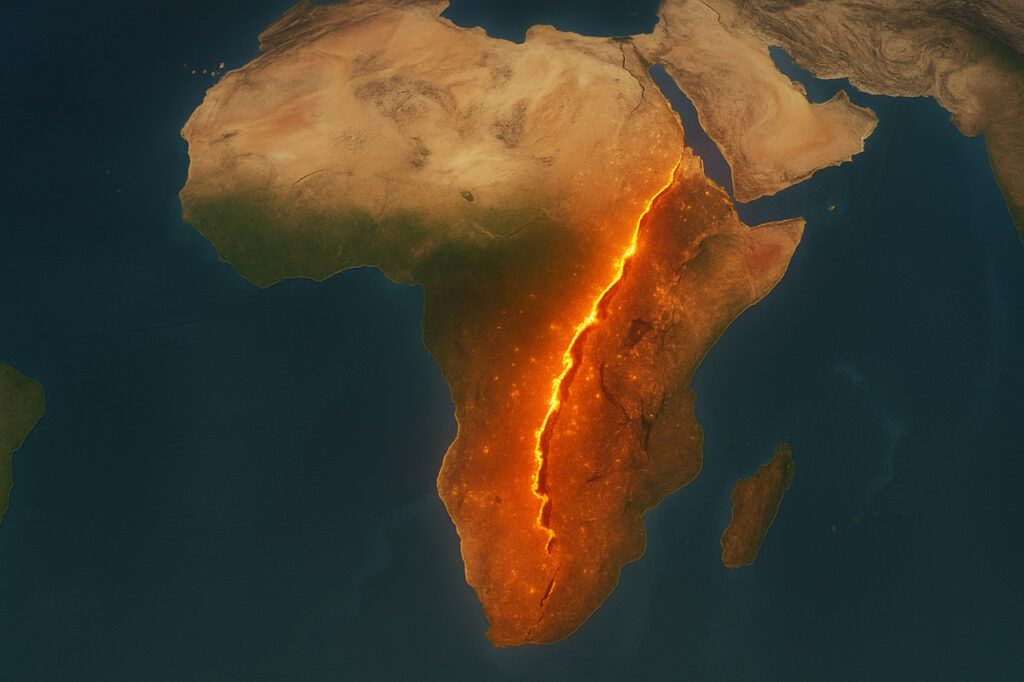
Just like ancient Pangea, which hundreds of millions of years ago broke apart to form today’s continents, Africa is writing a new chapter in Earth’s geological history.
The separation of the African continent is happening faster than scientists once imagined. Recent studies indicate that the geological process fragmenting East Africa has been accelerating, driven by intense underground forces and flows of molten rock emerging from the Earth’s mantle. Over millions of years, this transformation could result in the birth of a new ocean — and even a new continent.
Growing Fissures and Accelerated Plate Movement
The so-called East African Rift, also known as the Great Rift Valley, stretches for about 3,500 kilometers (2,175 miles) across countries such as Ethiopia, Tanzania, Kenya, Uganda, Mozambique, and the Democratic Republic of the Congo. It is one of the most remarkable — and unstable — geological structures on Earth.
Since 2005, when a 56-kilometer (35-mile) fissure opened in Ethiopia after a series of earthquakes, scientists have been observing the gradual separation between two major tectonic plates: the Somali Plate and the Nubian Plate, which together form the base of the African continent. Additional cracks appeared in Kenya in 2018, confirming that the process is ongoing.
Researchers from the University of California report that the separation is occurring at an average rate of about half a centimeter per year, suggesting a faster pace than older predictions — which estimated tens of millions of years for a full division. Now, some studies suggest that a new ocean could form within one to five million years if the current rate continues.
A Beating Heart Beneath Africa
Recent research led by the University of Southampton and published in Nature Geoscience revealed that the Afar region in Ethiopia is sustained by a hot mantle plume that pulses like a beating heart. This mass of molten rock rises from deep within the Earth and weakens the upper crust, promoting the formation of new fissures and volcanoes.
According to researcher Emma Watts, these pulses carry distinct chemical signatures that directly affect how the ground fractures. The team identified repetitive patterns in the region’s volcanic rocks, comparable to “geological barcodes,” which reveal the dynamic behavior of Earth’s interior.
These pulsations are linked to increased seismic and volcanic activity, including the formation of mountains such as Kilimanjaro. Active volcanoes like Suswa, Longonot, and Olkaria demonstrate that Africa’s subsurface remains in a constant state of transformation.
Environmental and Social Consequences
The impact of this phenomenon is already being felt on the surface. In Kenya, roads and railway lines have been damaged, and communities are living with cracks cutting through properties and farmlands. Some of these deep fissures are connected to the Earth’s mantle, releasing methane (CH₄) and sulfur dioxide (SO₂) — a concern for environmental authorities due to potential groundwater contamination.
If the separation continues, landlocked regions such as Uganda and Zambia could one day gain access to the sea, while new oceanic formations emerge between eastern and central Africa.
This transformation could reshape climate, biodiversity, and even the geopolitical landscape, creating new challenges and opportunities for trade and development. Though slow on a human timescale, it represents a profound and inevitable change in the planet’s structure.
A New Chapter in Geological History
Scientists emphasize that “Africa’s cracks are just another page in the planet’s geological manual” and that such transformations are part of the natural cycle of Earth’s crust. Even though no living human will witness the birth of this new ocean, the process is already underway.
As geologist Ken Macdonald summarized, “We’ll feel earthquakes, we’ll see volcanoes erupt, but we won’t see the ocean invade our land within our lifetimes.” Still, every fissure, every underground pulse, and every active volcano point toward the same destiny: a divided Africa and a new ocean being born at its heart.