A cinematic four-minute heist has shaken France and put one of the world’s greatest cultural treasures at risk.
The Louvre Museum in Paris experienced one of the most dramatic episodes in its recent history. In broad daylight, on Sunday, October 19, 2025, at 9:34 a.m., four thieves carried out a bold robbery lasting just four minutes, stealing eight French crown jewels valued at around $102 million (88 million euros). The event has turned into a real race against time to recover pieces that, according to experts, may already be lost forever.
What Was Stolen
Based on official information released by the Louvre Museum and the French Ministry of Culture, the list of the eight items that were effectively stolen and remain missing is as follows — all part of the historical collection of the French royal family:
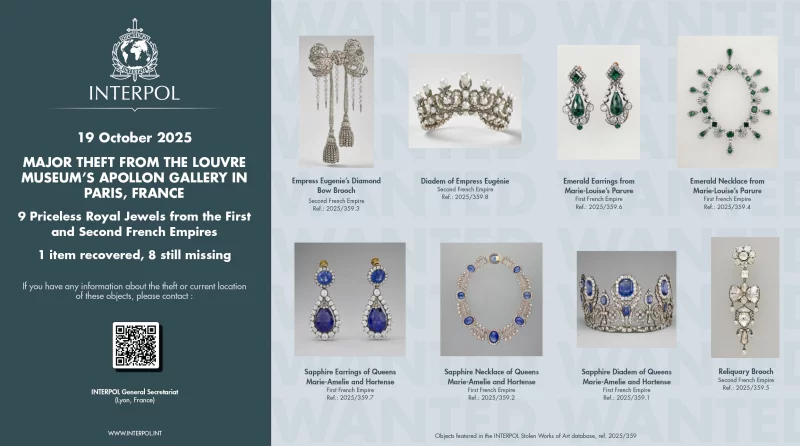
| Piece | Collection/Original Owner | Main Description |
| 1. Pearl Diadem (Tiara) | Empress Eugénie | Headpiece set with pearls and thousands of diamonds. |
| 2. Large Corsage Bow (Brooch) | Empress Eugénie | Large diamond brooch in the shape of a bow. |
| 3. Relic Brooch | Empress Eugénie/Imperial Collection | Diamond brooch often associated with the Mazarin diamonds. |
| 4. Sapphire Diadem (Tiara) | Queens Marie Amélie and Hortense | Headpiece set with Ceylon sapphires and diamonds. |
| 5. Sapphire Necklace | Queens Marie Amélie and Hortense | Necklace with sapphires and diamonds, part of the same set as item 4. |
| 6. Pair of Sapphire Earrings | Queens Marie Amélie and Hortense | Earrings matching items 4 and 5. |
| 7. Emerald Necklace | Empress Marie Louise | Necklace with emeralds and diamonds (a wedding gift from Napoleon I). |
| 8. Pair of Emerald Earrings | Empress Marie Louise | Earrings matching the emerald necklace (item 7). |
One of the most emblematic pieces is Empress Eugénie’s Crown, created in 1855 at the request of her husband Napoleon III, adorned with 2,490 diamonds and 56 emeralds.
Another notable item is the Pearl Diadem (or Tiara) of the Empress, commissioned by her husband in 1853, containing 212 pearls and 1,998 diamonds.
There is also the Sapphire and Diamond Diadem worn by Queen Marie Amélie, and the emerald necklace with 1,138 diamonds, a wedding gift from Napoleon Bonaparte to Marie Louise of Austria in 1810.
The Crown Left Behind
During the escape, one piece fell to the ground: the crown adorned with golden eagles, 2,490 diamonds, and 56 emeralds, worn by Empress Eugénie. Damaged in the fall, it was found broken in the gutter, becoming a symbol of negligence and national embarrassment.
After the heist, the museum decided to transfer the remaining jewels to the vault of the Bank of France, located just a few blocks away, in a secret, heavily guarded operation.
How the Robbery Happened
According to prosecutor Laure Beccuau, the robbery was meticulously planned. Four criminals split into pairs: two used a truck with a lift platform to reach the Galerie d’Apollon, while the other two waited on motorcycles to ensure a quick getaway.
They entered through a second-floor balcony, a spot without security cameras, and escaped on scooters just four minutes later, at 9:38 a.m.
Video shared as being the moment when the criminals descended the crane truck’s ladder with the jewelry
Todo o texto que vem abaixo do vídeo. Aqui ele terá largura maior e ficará mais legível, centralizado e com boa quebra de linha.
Suspected Inside Job
According to recent investigations revealed by the New York Post and Reuters, there are strong signs of internal involvement. Digital forensic records suggest that a member of the Louvre’s security team may have passed confidential surveillance information to the thieves.
This theory reinforces the professional nature of the heist. Some French prosecutors believe the crime may have been commissioned by a wealthy collector interested in the jewels, although most experts dismiss the notion of a “gentleman thief” in the style of Lupin.
Why the Jewels May Never Be Found
For art recovery experts, the outlook is bleak. According to Tobias Kormind, director of the European jeweler 77 Diamonds, it is “extremely unlikely that these jewels will ever be recovered.” The thieves likely dismantled the pieces, separating the diamonds, emeralds, and sapphires for resale on the international black market.
Once removed from their original settings and re-polished, these stones become impossible to trace, vanishing “from history forever.”
A Blow to French Pride
The theft of the French crown jewels is more than a material loss — it’s a blow to national pride.
Member of Parliament Maxime Michelet called the case “a shame for a country unable to protect the world’s greatest museum.”
Louvre Director Laurence des Cars even offered her resignation after being summoned by the French Senate to explain the security failures, but her request was rejected by the French Ministry of Culture.
French authorities are racing against time to recover the jewels and deliver a strong response to the public in an attempt to restore national pride. So far, two suspects have been detained.
Arrests Reveal Progress in the Louvre Heist Case, but the Mystery of the Jewels Remains
Two suspects involved in the Louvre Museum jewel theft, which occurred on October 19, were arrested on Saturday night, October 25, in the Paris region.
Attempted Escape
One of the suspects was intercepted at Charles de Gaulle Airport (Roissy) while preparing to board a flight to Algeria. The other was arrested hours later in the Paris area.
Suspects Were Already Known to Police
Both are about 30 years old and were already known to the police for previous criminal records. They remain in custody and are being investigated for organized theft and criminal conspiracy.
Empress’s Crown Was the Key Clue
Empress Eugénie’s Crown, which fell during the thieves’ escape, proved crucial to the investigation, as it left behind DNA samples and other evidence that helped identify the suspects.
Jewels Still Not Recovered
Despite the arrests, the eight stolen jewels have not yet been recovered. French police remain mobilized to locate the pieces and identify other possible accomplices.
More details about the case in the following video: