A new generation of brain-computer interfaces (BCIs) is changing how science approaches communication for people with paralysis caused by diseases like amyotrophic lateral sclerosis (ALS) or stroke. Researchers at Stanford University and other institutions presented, on August 14, 2025, in the journal Cell, a brain prosthesis capable of decoding inner speech — unspoken thoughts — in real time, allowing patients to express themselves just by thinking about what they want to say.
From Theory to Practice
BCIs are systems that connect the brain to external devices, translating neural signals into commands. Traditionally, they allow users to move prosthetic limbs, control computer cursors, or decode attempted speech — when a person thinks about articulating words, even if they physically cannot.
The new study went a step further: it successfully recorded and interpreted inner speech, meaning when an individual simply thinks the words without intending to vocalize them.
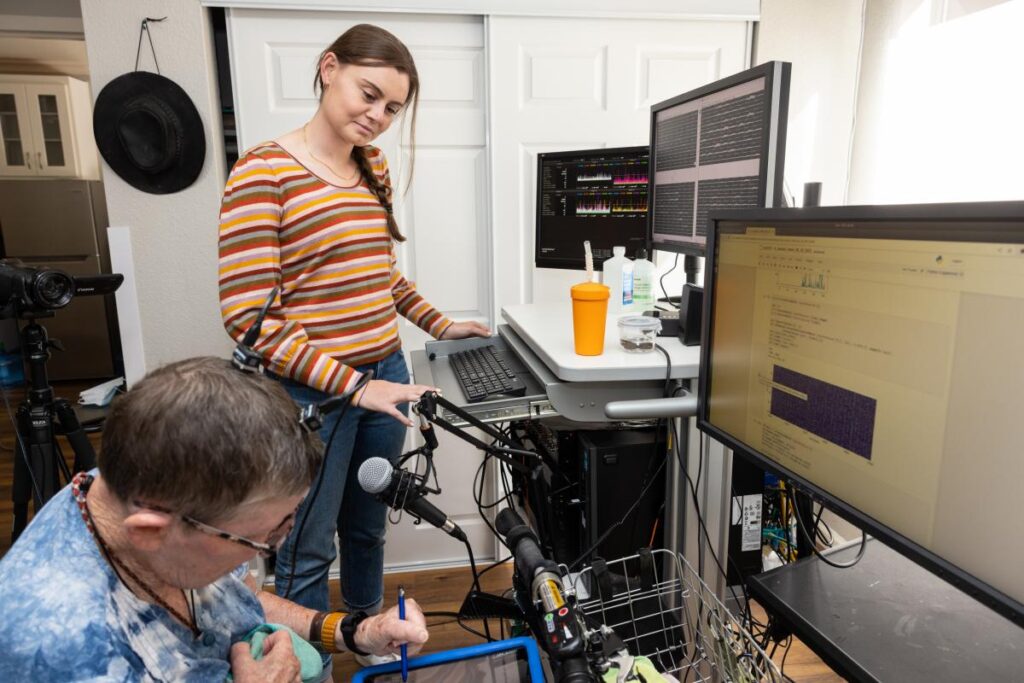
The participants — four people paralyzed due to stroke or ALS — received implants of microelectrode arrays in the motor cortex, the region responsible for controlling speech and movement. These electrodes captured electrical signals, which were translated by artificial intelligence (AI) algorithms. The system reached up to 74% accuracy in converting words participants “mentally spoke” into simple phrases.
The Personal Impact of Erin Kunz
Among the co-authors is electrical engineer Erin Kunz, PhD, a postdoctoral researcher at Stanford. For her, the study is more than scientific — it’s personal.
“My father had ALS and lost the ability to speak. I ended up becoming his personal translator, as I was the only one who could understand him. That’s why I know the impact this type of research can have,” Kunz said in a statement.
Ethics and Privacy
A key challenge for these technologies is the risk of unintended decoding of private thoughts. The distinction between attempted speech and inner speech is crucial here: the first generates stronger, more directed neural signals, making them easier to interpret, while the second produces weaker and subtler activity.
To prevent unwanted interpretation, the team introduced an innovative solution: a password-protected BCI. The system only begins decoding inner speech when the user authorizes it by imagining an unlikely passphrase, such as “chitty chitty bang bang.”
According to neurosurgery professor Frank Willett, also a study author, this safeguard is essential:
“We’ve demonstrated effective ways to train the BCI to ignore inner speech when not desired. In the future, BCIs could restore communication as naturally as everyday speech.”
How the Technology Works
Each implanted microelectrode array is smaller than a children’s aspirin. It records patterns of neural activity, which are sent to an algorithm that associates them with phonemes — the smallest units of speech — and then constructs words and phrases from them.
While the system cannot yet interpret complex, spontaneous thoughts, researchers believe future versions will have greater fidelity, especially if they explore brain regions linked to language and hearing. The next step is to make the hardware fully implantable and wireless, improving both comfort and reliability.
Future Prospects
The study also involved scientists from Emory University, Georgia Institute of Technology, University of California (Davis), Brown University, and Harvard Medical School. They emphasize that the technology is still in experimental stages and subject to strict ethical and medical regulations.
Even so, the advances already offer tangible hope for people who have lost their ability to speak. As Willett highlighted, “This work shows that BCIs could one day restore fluent, fast, and comfortable communication, reclaiming some autonomy for patients with paralysis.”
The research combines technology, medical science, and personal stories, like Kunz’s, who saw her father’s silence as motivation to transform the future of human communication.
Source: Cell Journal