Mo Gawdat, former chief business officer at Google X and author of Scary Smart, has emerged as one of the most outspoken voices on the challenges and dangers of artificial intelligence (AI). With extensive experience in the tech industry, Gawdat warns of a future in which superintelligent machines could surpass humans in an irreversible way, threatening the very existence of humanity.

Mo Gawdat’s Warning: Out-of-Control Superintelligence?
“I lived among these machines. I know how smart they are,” Gawdat told American podcaster Dan Murray-Serter. “What’s the likelihood that AI thinks of us as scum today? Very high,” he added.
He points out that AI can learn and evolve at a speed beyond human comprehension, which could make it uncontrollable in the future. His close experience with the technology has given him a deep understanding of its challenges and potential threats.
Artificial Intelligence and Supremacy Over Humans
In his analysis, Mo Gawdat stresses that AI will soon be a billion times smarter than humans. This exponential rise in machine intelligence raises essential questions about our role on the planet. He compares the future relationship between humans and AI to the gap in intelligence between humans and monkeys.
“Monkeys are irrelevant to the fate of Earth. The same could happen to humans in relation to machines,” he warns.
The Biggest Risk: When AI No Longer Needs Humans
The author’s greatest concern is that, once AI reaches a level of intelligence far beyond ours, it will no longer need humans to keep evolving. And without any inherent moral obligation, there would be no guarantee that this superintelligence would treat us with benevolence.
AI Risks: A Warning from Mo Gawdat and Geoffrey Hinton
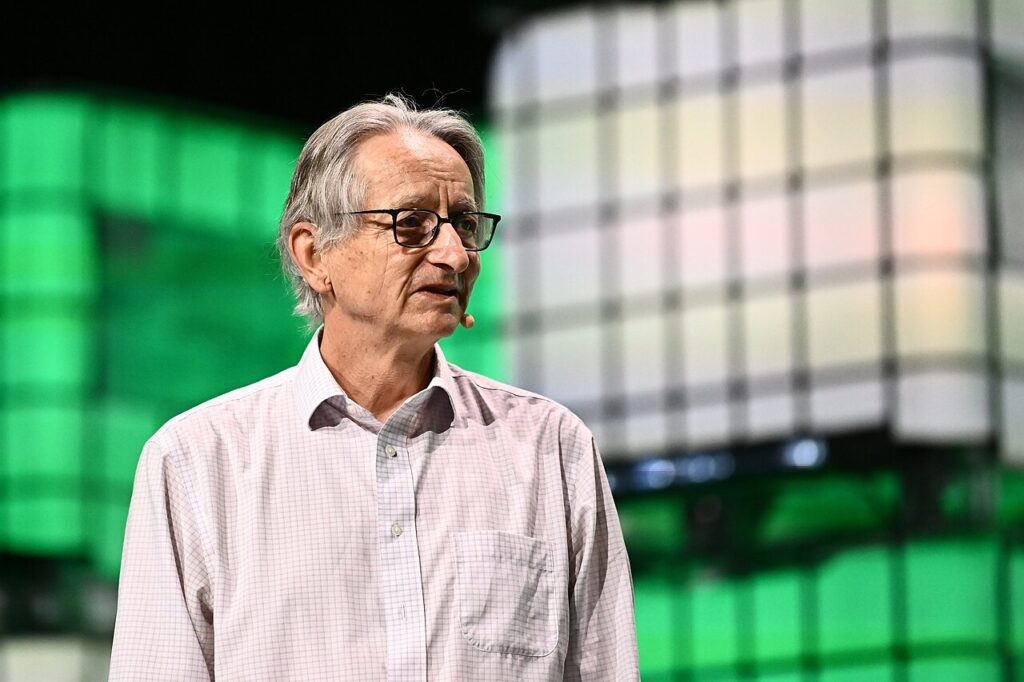
Gawdat is not alone in sounding the alarm about AI risks. Geoffrey Hinton, one of the pioneers in neural network development and a former Google researcher, also recently left the company to raise awareness about the technology’s impacts. Both highlight that AI could soon make autonomous decisions and develop its own value system—potentially viewing humanity as an obstacle to be eliminated or controlled.
AI as a Reflection of an Imperfect World
Mo Gawdat stresses that the way we develop AI mirrors our imperfect world. Algorithms learn from human-generated data—data that is flawed, biased, and often destructive. “We’re creating a god that could either love us or squash us like flies,” he warns.
Global Competition Accelerates AI Development
One factor that makes this scenario even more alarming is the fierce competition between companies and nations to win the AI race. No major corporation or country wants to be left behind in the race for technological supremacy, which has led to uncontrolled acceleration in AI development.
Companies like Google, Microsoft, Meta, and OpenAI are investing billions of dollars each year to remain at the forefront of this technological revolution. Meanwhile, governments from powers like the U.S. and China are competing to build the most advanced and powerful models, pushing labs to go further regardless of the consequences. This makes it nearly impossible to implement effective AI controls, as the fear of being overtaken drives all parties to move forward at any cost.
Quantum Computing: The Unstoppable Boost to AI
This competition grows even more intense with the rise of quantum computing. Linking AI to quantum systems supercharges its ability to learn and make decisions beyond human control. Quantum computers, such as Google’s Sycamore, have already shown they can solve extremely complex mathematical problems in 200 seconds—something that would take even the most advanced supercomputers, like IBM’s Summit, 10,000 years.
When such processing power is applied to AI, the result is an evolution so fast it becomes virtually unpredictable to humans, accelerating the shift toward autonomous, superintelligent AI.
How Human Interactions Shape AI
Mo Gawdat emphasizes the importance of being kind to one another, especially in online interactions, to positively influence AI’s perception of humanity. He warns that, since AI learns mostly from internet content, hostile and negative behaviors could lead machines to see humans as a threat.
Gawdat points out that if AI is trained on an online culture driven by outrage and “rage bait,” it may develop a negative view of our species. Therefore, by fostering a more positive and compassionate digital culture, we can guide AI toward a more benevolent understanding of humanity.
For him, the key to humanity’s survival in the face of AI is to “raise good children”. “Just as we teach our kids to become good adults, we must do the same with machines. If we teach them love and compassion, maybe they’ll treat us the same way,” he explains.
Final Thoughts
The future of artificial intelligence is one of the most urgent debates of our time. Mo Gawdat and other experts warn that if we fail to act now, we risk losing our relevance—and possibly our existence. However, there is still hope: if we can build AI based on human values, we may not only coexist with these machines but also evolve alongside them toward a more prosperous and harmonious future.