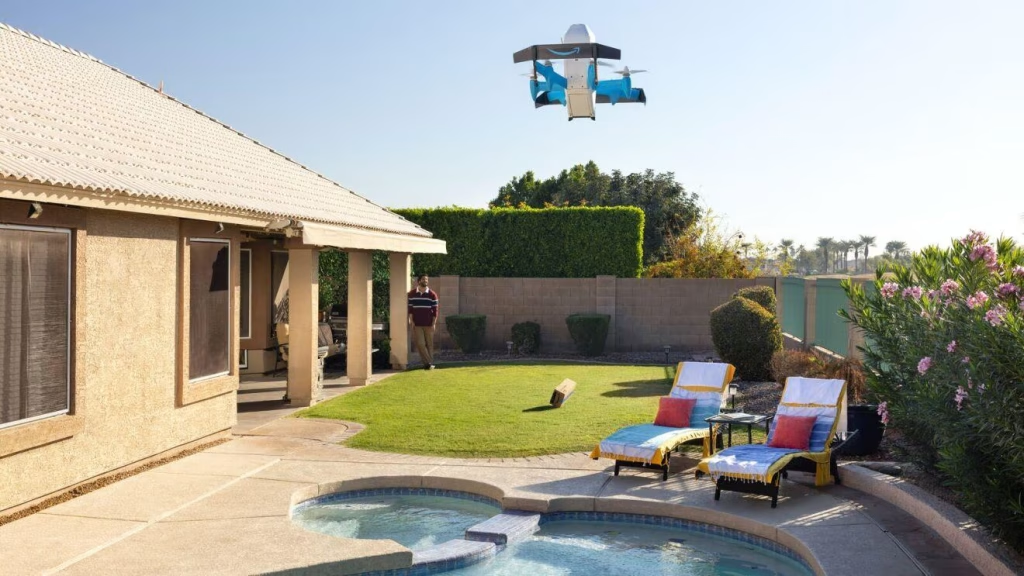
Prime Air’s expansion is fueling complaints about noise, privacy and its effects on wildlife, while Amazon defends the convenience and benefits of the service.
What You Need to Know:
- “They’re stealing the sky”: In Baton Rouge, Louisiana, residents packed a meeting at a local church to demand answers from Amazon about its Prime Air delivery drones. Retiree Rick LeCompte’s words summed up the frustration.
- 18 flyovers in 21 minutes: One resident counted the drones passing overhead, while a sound engineer recorded noise levels as high as 87 decibels in his backyard — and some complain the aircraft have been disrupting funerals at a local cemetery.
- The dispute could spread across the U.S.: Amazon operates across 18 locations in 10 states and aims to reach nearly 500 cities by the end of the year. Yet some residents love the service — Monica Anderson says her kids get disappointed when a drone delivers a package while they’re at school. As the rollout expands, the ACLU poses the question the country may have to answer: “Do Americans actually want this?”
In Baton Rouge, Louisiana, Amazon drone deliveries have sparked a clash between the company and some of its neighbors. In October, residents packed a church meeting to demand answers about noise, how the company uses drone footage and the effects on birds. According to The Wall Street Journal, retiree Rick LeCompte summed up the frustration this way: “They’re stealing the sky.”
Prime Air Is Scaling Up
According to Amazon, its Prime Air drones weigh about 80 pounds (36 kg) and have been flying in Baton Rouge since July. Roughly 30 aircraft per hour carry packages of up to 5 pounds (2.3 kg) to homes within a 7.5-mile (12 km) radius. The service operates at 18 sites across 10 states, and Amazon aims to reach nearly 500 cities by the end of the year.
The operation relies on an FAA waiver that allows autonomous flights beyond visual line of sight. More than half of the 900,000 drones registered in the U.S. are commercial, and the agency projects the total will hit 3.5 million by 2030, according to The Wall Street Journal.
Residents Question the Flights
At the meeting, residents asked what Amazon does with the footage its drones capture and whether the aircraft scare off birds. They also presented measurements and firsthand accounts:
- Sound designer Michael Cole recorded noise levels of up to 87 decibels in his own backyard.
- Bob Storer counted 18 flyovers in 21 minutes.
- One attendee said the drones interfere with funerals at a nearby cemetery.
- Kay Radlauer and Dennis Demcheck planted native species to attract hummingbirds and woodpeckers, but say they saw three drones in 30 minutes.
Amazon’s Response
The company says it has adjusted flight altitudes and spread out air traffic. It describes the noise as minimal and brief, comparable to a passing car.
On privacy, Amazon says its drones don’t identify people, don’t use facial recognition and don’t record audio. The company says employees don’t watch live feeds and that the footage is not sold or used for advertising. It adds that images are shared with government agencies, including police, only when required by law or to protect the safety and rights of customers, employees or the public. Amazon also says it conducts environmental assessments to protect wildlife.
Some residents see it differently. Raven Cole, a teacher in the Broadmoor neighborhood, had blamed the drones for fewer bird sightings. After one drone passed, though, she spotted a hawk circling above it. “The hawk is back!” she exclaimed.
Backlash Extends Beyond Louisiana
Resistance is already surfacing in other states. In Richardson, Texas, residents protested and formed a group called Quiet Skies Texas. In Westborough, Massachusetts, Amazon pulled the program before launch and has promised to present a revised plan.
Jay Stanley of the ACLU (American Civil Liberties Union) says clear privacy rules should be in place before anyone backs drone deliveries. “The big open question is: Do Americans want this?” he told the paper. The FAA says primary responsibility lies with operators and local leaders.
Jobs vs. Convenience
Democratic city councilman Cleve Dunn Jr., who organized the meeting, says Amazon invested $200 million in the distribution center, which was built on the site of a former shopping mall. He says the project created 2,000 jobs and revitalized a run-down area. “Don’t let the loud minority shut this place down,” he said.
Not everyone shares the complaints. Monica Anderson, who works from home, says her kids are disappointed when a drone drops off a package while they’re at school. “It’s really cool,” she said.
Many residents report quieter skies since the company’s adjustments, though some notice more traffic in other areas. Radlauer acknowledges the drones have gotten quieter but remains unhappy. She says critics aren’t radicals. They’re Amazon Prime customers who want to be heard.
Sources & References
- The Wall Street Journal (Nov. 15, 2026) – The Backyard Battle Over Amazon Delivery Drones ‘Stealing the Sky’, by Kris Maher.
- DroneXL (Nov. 15, 2026) – Amazon Changed Baton Rouge Drone Routes After 100 Neighbors Showed Up, by Haye Kesteloo.
- About Amazon (Aug. 19, 2026) – Amazon Prime Air drone delivery is expanding to nearly 500 US cities and towns this year, by Tyler Greenawalt.
- SpectrumVote (2026) – Who is Cleve Dunn, Jr.? Councilmember, Metro District 6, East Baton Rouge Parish