The new Tesla Roadster used compressed-gas thrusters to perform aerial maneuvers. But the demo didn’t prove it can sustain flight or carry passengers.
What You Need to Know
- The car actually left the ground: During a demonstration in Texas, the Tesla Roadster prototype flipped in midair and landed smoothly on its wheels.
- Ten thrusters and 600 liters of compressed air: According to TechCrunch, the system uses cold-gas thrusters to execute aerial maneuvers, though long-range flight was not demonstrated.
- A true flying car is yet to be proven: The event provided no proof that the Roadster can sustain prolonged flight with passengers onboard or bypass city traffic through the air.
Tesla’s new Roadster, unveiled by Elon Musk on October 15, 2026, grabbed headlines by seemingly defying gravity. The sports car lifted off the ground, spun in midair, and landed back on its wheels.
Do a kickflip! https://t.co/DJ1Bq1yu8m
— Tesla (@Tesla) October 16, 2026
The demo took place at a SpaceX facility in Texas. It showcased a prototype that blends automotive engineering with propulsion technology inspired by aerospace systems. According to the Associated Press (AP), the vehicle operated autonomously, with no human driver on board.
So what did the demo actually prove about the Roadster’s ability to fly?
How Does the Car Get Off the Ground?
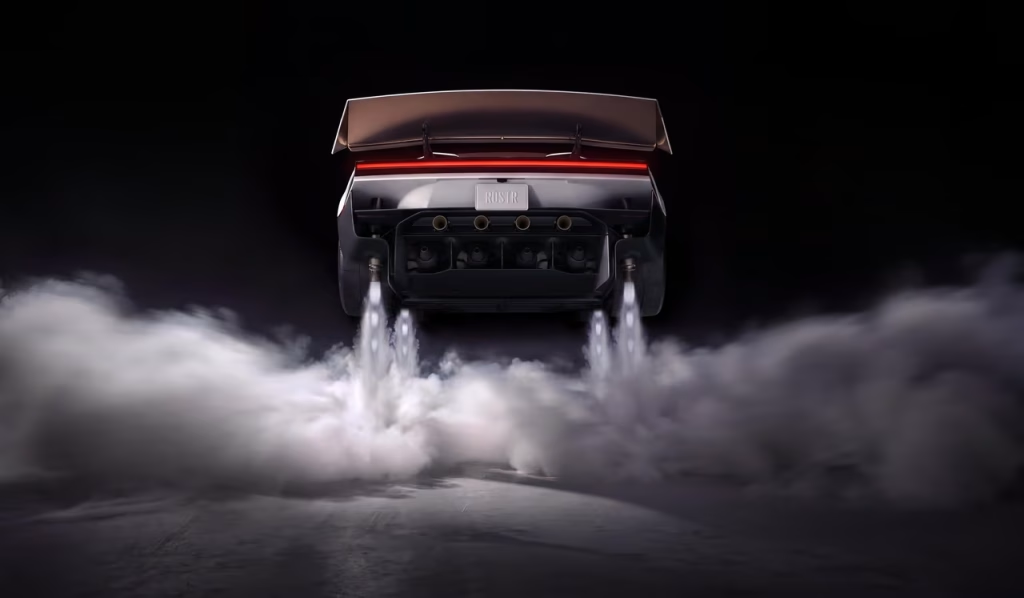
Tesla showed its most advanced Roadster versions with compressed-gas thrusters developed with SpaceX technology. During the demo, the system generated bursts of thrust strong enough to lift the vehicle, spin it in the air, and control its descent.
Lars Moravy, Tesla’s vice president of vehicle engineering, said the system uses 10 thrusters connected to tanks with a combined capacity of 600 liters of compressed air, according to TechCrunch.
The demo also showed the car driving upside down along a curved ramp before launching into the air and performing a rotation. A suction system under the vehicle helps keep it pinned to the ramp during the maneuver.
Real life, baby https://t.co/3QEqn18wig
— Tesla (@Tesla) October 16, 2026
The distinction matters: the suction system holds the car to the surface, while the thrusters provide the bursts that make the aerial maneuvers possible.
Can the Roadster Fly Long Distances?
This remains the biggest unanswered question.
The prototype performed aerial maneuvers, but the public demo did not prove it can sustain flight, cover significant distances through the air, or carry passengers in conventional flight.
For now, there is no public demonstration suggesting the Roadster could replace a plane or helicopter, or let drivers fly over traffic jams and busy streets.
In the U.S., aircraft are subject to aviation safety, certification, and operating rules. The Federal Aviation Administration (FAA) has outlined several operational possibilities for eVTOLs (electric vertical takeoff and landing aircraft), including use of existing infrastructure and routes, and the eventual development of dedicated corridors.
Not every eVTOL has to use pre-approved corridors. It’s still unclear how the FAA would classify the Roadster, or what requirements it would have to meet to fly.
When Will the New Tesla Roadster Hit the Market?
Tesla expects to start production in 2028. However, the second-generation Roadster has endured repeated delays since it was first unveiled in 2017.
The most ambitious version, called Rocket, was described as having a propulsion system built for aerial maneuvers and a single-seat configuration. Still, it’s unclear which approvals the model would need to operate in the air.
Tesla plans to offer three Roadster configurations:
- Performance: a two-seater without compressed-gas thrusters, with a claimed 0–60 mph time of under 1.6 seconds.
- Thrust: also a two-seater, adding rear thrusters, with a claimed 0–60 mph time of under 0.9 seconds. It was not presented as the version capable of flight.
- Rocket: the single-seat version described above, built for aerial maneuvers. Invite only, and not approved for public road use.
Tesla’s claimed 0–60 mph times have yet to be confirmed by independent testing.
The Bottom Line
For now, the Roadster is an unusual feat of engineering, not a flying car with demonstrated sustained-flight capabilities.
Sources & References
- Associated Press: Tesla Roadster demonstration and reveal event details
- TechCrunch: Technical breakdown of gas thrusters and suction system
- Associated Press: Additional details on the prototype demonstration in Texas
- FAA: Aerospace safety regulations and operational guidelines
- Reuters: Launch timeline, historical delays, and production outlook
- TechCrunch: In-depth engineering analysis of the SpaceX-powered system
- American Cars and Racing: Acceleration metrics and performance specifications