Service sold on Telegram via monthly subscription used artificial intelligence to hijack emails, map out victims, and plan financial fraud on a global scale
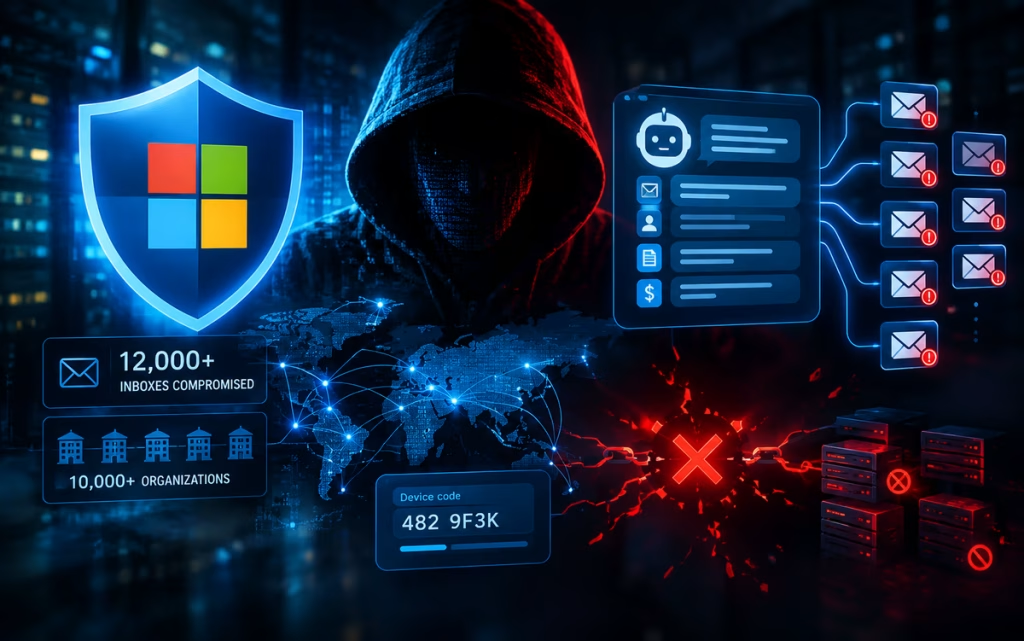
🔍 What You Need to Know: EvilTokens
- The AI didn’t just write messages — it CHOSE the victims: The chatbot analyzed up to 5,000 compromised emails simultaneously, mapping trust relationships and identifying who would be most profitable to impersonate.
- “Device code phishing”: The victim received customized lures (bid proposals, contracts, password alerts) and, upon clicking, was directed to a process that generated a fraudulent code. They then entered that code on Microsoft’s LEGITIMATE page — without entering any password — and granted access to their own account. The technique exploited a system originally designed for TVs.
- Criminals also used AI to BUILD the tool: Large parts of the platform were developed with “vibe coding”, showing how artificial intelligence lowered the barriers both to building and to operating attacks at global scale.
Microsoft announced the takedown of EvilTokens, a cybercrime platform that used artificial intelligence at every stage of an attack — from breaking into email accounts to crafting sophisticated financial scams.
At the core of the service was an AI chatbot capable of scanning a victim’s inbox to identify trust relationships, payment authorizations, and sensitive responsibilities within an organization. The tool could analyze 5,000 compromised emails simultaneously.
The AI Didn’t Just Write Messages — It Chose the Victims
Artificial intelligence wasn’t just helping criminals write more convincing messages. It was deciding who to target, who to impersonate, and how to exploit that relationship as profitably as possible.
Global Reach in Just a Few Months
Launched in February 2026, EvilTokens had already been linked to more than 12,000 compromised inboxes across more than 10,000 organizations worldwide.
The hardest-hit countries were:
- United States
- Canada
- United Kingdom
- Australia
- India
- France
Victims included companies in distribution, construction, financial services, real estate, higher education, and healthcare. Coinbase traced roughly $1.1 million in revenue generated by the platform.
How the Scam Began: “Device Code Phishing”
EvilTokens exploited a technique known as “device code phishing“ to break into accounts.
Victims received customized phishing lures disguised as construction bid proposals, business partnership contracts, compensation and benefits notices, or password expiration alerts. Once a victim clicked the link, an automated script generated a fraudulent code.
The victim then entered that code on Microsoft’s legitimate login page — and, without typing a password, unknowingly granted access to their own account.
Behind the scenes, EvilTokens relied on backend logic built in Node.js to automate steps of the attack and dodge detection by traditional signature- or pattern-based security systems.
The method exploited an authentication system originally designed for TVs and other devices with limited input capabilities.
What the AI Did Once Inside the Inbox
Once inside a compromised account, the AI tool took over the heavy lifting:
- Summarized and translated emails
- Mapped out organizational roles
- Identified conversations about wire transfers
- Located vendor invoices
- Suggested who would be easiest to impersonate
After compromising an account, criminals could also craft new phishing emails based on information found in the inbox — including impersonating trusted contacts to make the scams more convincing.
A Full-Fledged “Product,” Sold as a Subscription
EvilTokens was sold on Telegram for a $1,500 sign-up fee plus $500 a month, complete with management dashboards and customer support — operating like a genuine piece of commercial software.
The Irony: The Tool Itself Was Built With AI
Large portions of the platform were built using “vibe coding” — meaning the criminals themselves also used artificial intelligence to help develop the tool.
Microsoft said AI lowered the barriers on both ends of the operation: both in building the platform and in using it to carry out attacks.
How the Operation Was Taken Down
The effort brought together Microsoft, Health-ISAC, Cloudflare, Coinbase, OpenAI, Railway, SpyCloud, The Shadowserver Foundation, and TRM Labs.
With authorization from the U.S. District Court for the Eastern District of Virginia, the coalition seized 50 websites and took down more than 150 supporting domains.
Arrests in the UK
On September 11, 2026, London’s Metropolitan Police Service arrested two men, ages 32 and 38, in connection with EvilTokens. Both were released on bail while the investigation continues.
A Milestone in the Fight Against AI-Powered Cybercrime
This marked the 40th court-authorized takedown by Microsoft’s Digital Crimes Unit — and the first ever against an end-to-end, AI-enabled cybercrime service.
The Warning for Businesses Going Forward
According to Microsoft, the criminal playbook demonstrated by EvilTokens won’t disappear along with the platform. The company’s recommendation for organizations: assume that once an inbox is compromised, criminals can understand its contents in minutes — not days.
Beyond strong identity protections, businesses should also independently verify, through a second trusted channel, any request to change payment details, redirect funds, or approve unusual transactions.
Sources and References
- Microsoft (Sep. 2026). Disrupting EvilTokens: The AI chatbot built for cybercrime. Access here.
- Ars Technica (Sep. 2026). Microsoft disrupts AI-assisted platform that compromised 12,000. Access here.
- Axios (Sep. 2026). Microsoft takes down EvilTokens cybercrime platform. Access here.