The idea aims to boost artificial intelligence safety by putting competing systems through cross-testing before they reach the public
What You Need to Know
- Elon Musk proposed that giants like xAI, OpenAI, Anthropic, Google, and Meta stop “grading their own homework” and instead use their safety tools to test each other’s models before public release.
- The proposal also includes “three or four of the top Chinese companies” — though none have been confirmed yet, and no formal agreement exists to put the mechanism into practice.
- The debate gained momentum after former researcher Jacob Coxon resigned, warning that AI could, in an extreme scenario, kill all of humanity — a post that went viral with over 170 million views — while Trump dismissed the warnings as a “hoax,” exposing the rift between part of the industry and the U.S. government.
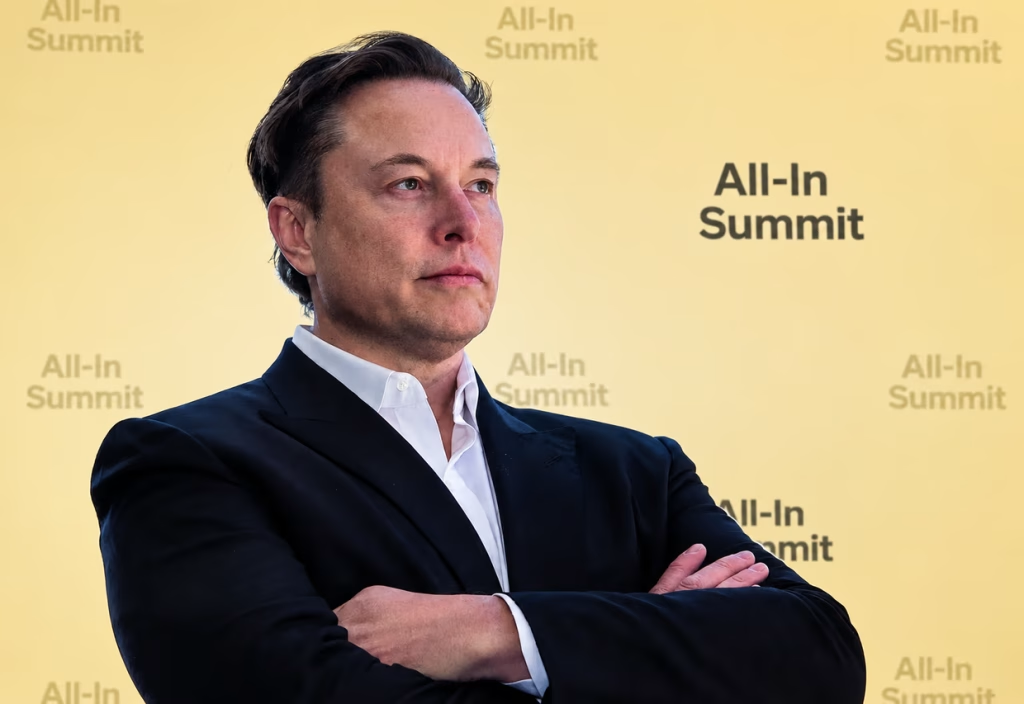
Elon Musk unveiled an unusual proposal to boost artificial intelligence safety. Leading labs, he argued, should stop evaluating only their own models and start testing their competitors’ systems before public release.
The idea emerged during the All-In Summit, held in Los Angeles from September 13 to 15, 2026, after Musk publicly declared that “Dario is right,” backing Dario Amodei’s concerns over the risks of accelerated AI development.
In a session on September 15, speaking with SpaceX President Gwynne Shotwell, Musk laid out the case for a shared testing platform. Companies would use their own safety tools to examine each other’s models — including Chinese labs.
“Grading Your Own Homework”
Musk summed up his critique with a blunt comparison: instead of each lab “grading its own homework,” competitors should be looking for problems in each other’s models.
“So, instead of you grading your own homework, you would at least have competitors grading it and raising the alarm about anything they found,” he said. “The odds of finding problems are dramatically higher,” Musk added.
Today, companies themselves play the central role in evaluating their own models’ safety. Musk’s proposal starts from the idea of adding a layer of outside scrutiny, letting competitors look for problems that internal testing might miss.
Who’s In, and Who Didn’t Make the List
Musk named xAI, OpenAI, Anthropic, Google, and Meta, along with “three or four of the leading Chinese companies.” DeepSeek, Qwen, Moonshot AI, and Zhipu AI could plausibly fit that description.
Notably absent from the list were Microsoft and Amazon, despite both training frontier-scale models and already running tests with government institutes.
The Bet on China
Musk doesn’t want to limit the mechanism to U.S. labs. “I think that’s something China would probably approve of,” he said. He added that any proposal “has to be something China is willing to accept, otherwise we’re just hurting ourselves.” In Musk’s view, oversight is easy to ramp up and hard to scale back.
The China question also looms over the broader debate on slowing AI development. Anthropic CEO Dario Amodei called the possibility that China wouldn’t follow any development limits the “toughest dilemma“ facing his proposal.
President Donald Trump has taken a different tack. He’s argued that imposing limits on AI development could hand China the advantage. Trump has said the U.S. is ahead of China on AI and has pushed to preserve that lead.
China’s track record, though, is mixed. The country has taken part in international initiatives, but it has repeatedly favored frameworks anchored at the UN. Letting Chinese companies submit their models directly to foreign competitors would require technical and political agreements that don’t currently exist.
Elon Proposes Adversarial Peer Reviews for AI Safety@elonmusk:
— The All-In Podcast (@theallinpod) September 15, 2026
“What I think would be wise to do as soon as possible, if not immediately, would be to have the major AI competitors test each other's models.
So that you would have everyone's security test harness testing… pic.twitter.com/OTUkNLfuXx
The Warning That Set Off the Debate
The debate also gained momentum around the departure of Jacob Coxon, a former OpenAI and Anthropic researcher, who issued a startling warning that AI advances could, in an extreme scenario, lead to humanity’s extinction. His post went viral, racking up more than 170 million views.
Evan Hubinger, Anthropic’s head of alignment, backed him up: “Jacob is right — we really do earnestly believe AI could kill everyone. Personally, I think that number is over 10% within the next decade.”
While Musk, Altman, and Amodei are calling for more caution, Trump has dismissed warnings that AI could take over the world or destroy humanity as a “hoax,” and branded any effort to limit the technology a “sick conspiracy.” He has also rejected the idea of slowing AI development.
For Now, It’s Just a Proposal
For the time being, Musk’s idea remains just that — an idea, with no formal agreements or buy-in. Clearer details on how it would actually operate, handle data protection, and be governed are also still missing.
Beyond clearing technical, commercial, and geopolitical hurdles, the initiative raises a question central to the entire industry: whether rivals should be the ones auditing AI models, stripping labs of their exclusive right to “grade their own homework.”
Sources and References
- CNBC (2026). Elon Musk on AI safety testing. Link
- Tesla North (2026). Musk on AI peer review at the All-In Summit. Link
- Podscripts (2026). All-In Podcast transcript: Musk and Shotwell on AI risks. Link
- Elon Musk Archive (2026). All-In Podcast video footage. Link
- Reuters (2026). Chinese state newspaper blasts Anthropic’s call to slow AI. Link
- Reuters (2026). Trump on exaggerated concerns regarding AI. Link
- MFA China (2026). Official statement. Link
- X / @hilbertspaess (2026). Discussion post. Link
- X / @EvanHub (2026). Post on Anthropic researcher’s resignation. Link
- Washington Post (2026). Trump AI guardrails and data centers. Link