New policy reveals when restrictions come from governments — showing how Brazilian users can bypass the algorithmic restriction while India demands absolute secrecy.
🔍What You Need to Know
- Automatic notifications: X will notify users whenever a government requests the removal of a post or the restriction of an account, identifying the agency responsible and, when possible, the legal basis for the request.
- Brazil vs. India: In Brazil, the filter that currently suppresses posts from 665 accounts flagged by the TSE is public and reversible — simply following an account bypasses the restriction —, while in India, the same level of transparency is prohibited by law, leaving users unaware of who requested the block or why.
- The numbers tell an ironic story: even as Musk criticizes European regulation — which has already resulted in a €120 million fine for X — the platform complied with between 83% and 98.8% of government removal requests, depending on the region and period, a higher rate than under the previous Twitter management. The difference, Musk argues, is that the public now knows who is pulling the trigger on censorship.
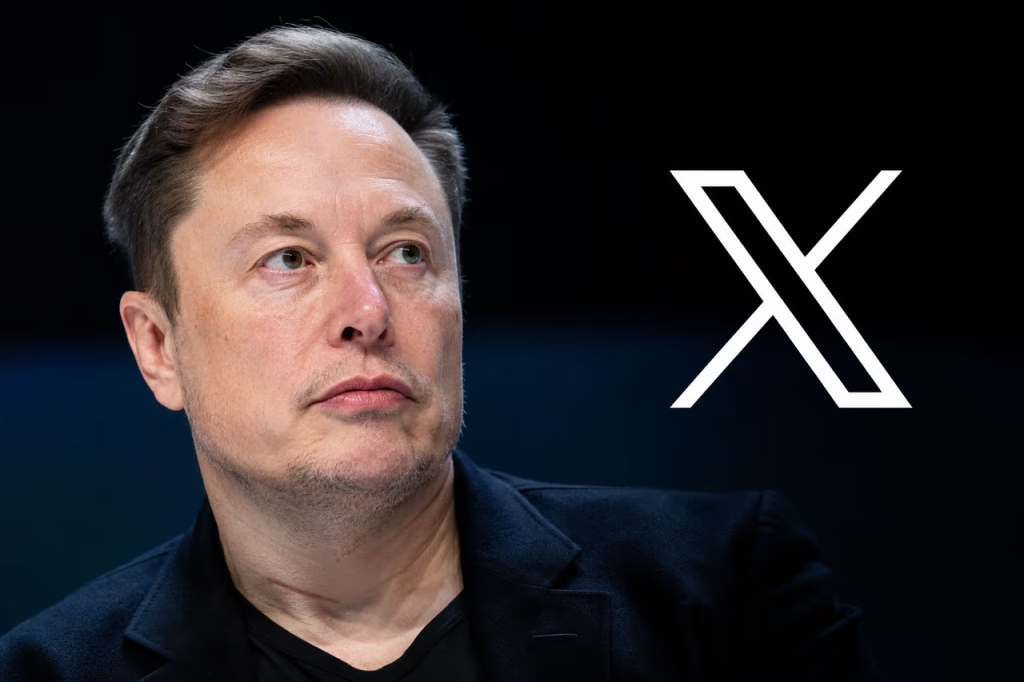
Elon Musk announced a new policy on X designed to expose the heavy hand of the state in content moderation. On August 15, the entrepreneur was direct: “Any censorship required by governments is now clearly visible.”
Any censorship required by governments is now clearly visible https://t.co/eQMdoYlhkA
— Elon Musk (@elonmusk) August 15, 2026
From now on, users will be notified whenever an authority demands the removal of posts or the restriction of accounts, with the agency identified and the legal justification provided.
The move is a direct response to the wounds exposed in the 2022 Twitter Files. Under the previous management, the platform applied “visibility filtering” (shadowbanning) in secret.
High-profile conservative figures in the United States—such as Dan Bongino, Charlie Kirk, and Stanford professor Jay Bhattacharya—appeared on hidden blacklists labeled “Do Not Amplify.” Donald Trump’s account was also permanently suspended in January 2021. Musk aims to prove that the era of silent shadowbanning is over.
The Brazilian Model: Transparency and the “Follow” Loophole
The most striking implementation of the new policy took place in Brazil. In August, X updated its open-source code on GitHub to include the Brazil2026ElectionFilter.
Created to comply with orders from Brazil’s Superior Electoral Court (TSE) ahead of the October 4 elections, the code removes posts from 665 flagged accounts from the “For You” feed.
The key safeguard for free speech in the Brazilian model is that the restriction is not absolute: if a user chooses to manually follow the restricted account, the filter is lifted and the content reappears. Paid promotions are also exempt.
For the first time, a government censorship demand has become public, auditable lines of code citing the legal basis and the ID of every affected account.
India and Europe: When the Law Prohibits Transparency
While Brazil has become a showcase for transparency, India exposes the limits of Musk’s strategy. In the Asian country, Section 69A of the Information Technology Act imposes strict confidentiality.
When the Indian government ordered the blocking of 2,355 accounts in just one hour in July 2025—including Reuters’ profiles—X complied and later publicly disclosed the demand. The government denied issuing the order, and the Reuters accounts were only restored after intense public protests.
Without details about the orders, Indian users receive only the generic notice that an account has been “withheld in India.” In 2025, the Indian government issued an astonishing 24,300 secret blocking orders.
In the European Union, the pressure is regulatory. On December 5, 2025, the European Commission imposed a €120 million fine (approximately $138 million) on X for violations of the Digital Services Act (DSA)—the first non-compliance decision under the regulation.
The sanction involved advertising transparency, researcher access to data, and verification badges. X, Musk, and xAI Holdings appealed to the EU General Court on February 16, 2026.
Musk criticizes the DSA for pressuring platforms into proactive censorship; the EU maintains that the rules are neutral and focused on accountability.
The final irony? Data from Crypto Briefing shows that under Musk’s leadership, X complied with between 83% and 98.8% (varying depending on the half-year analyzed and the region) of government removal requests—a higher rate than under the previous management.
The difference, Musk argues, is that the public now knows exactly who is pulling the trigger on censorship.
Sources & References
- Brussels Signal — Coverage on the announcement of government censorship request visibility on X.
- The Twitter Files — Documentation and investigations into content moderation and internal targeting.
- GitHub / xAI Organization — Official repository containing updates to the X algorithm.
- LegitQuest — Legal text regarding rules and procedures for blocking content in India.
- India Today — News coverage on government orders to block accounts in India.
- The Indian Express — Analysis of the surge in content removal requests nationwide.
- AP News — Coverage on regulatory disputes and fines between X and the European Union.
- Crypto Briefing — Report analyzing statistics on government request compliance by the platform.