The Secret Beneath the Tracks
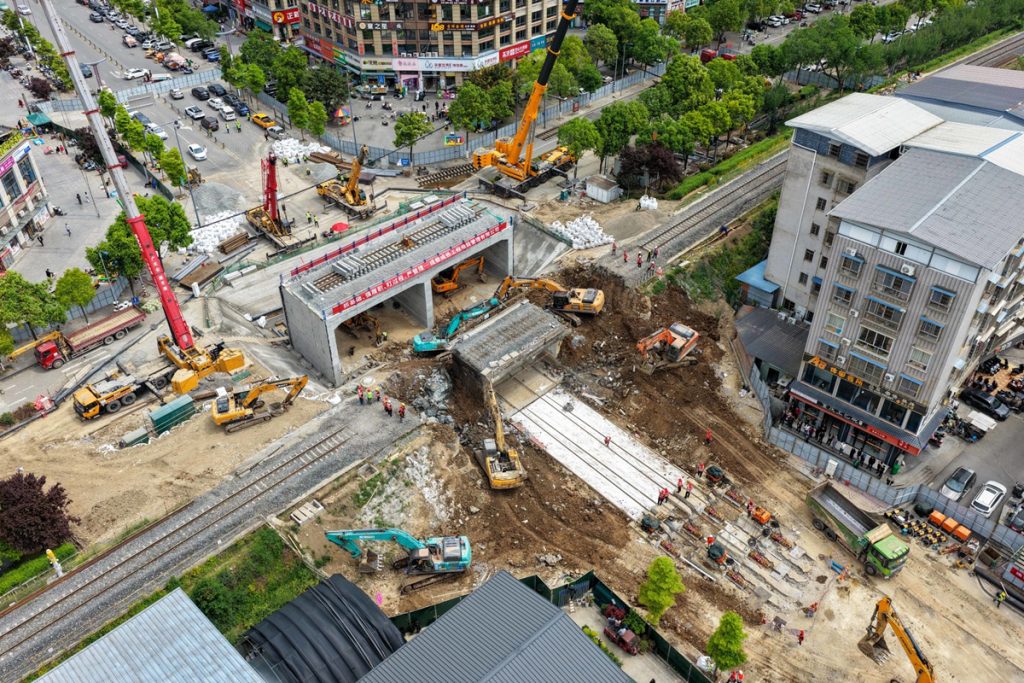
An engineering operation that looks like something out of a movie has captured attention in China. In just 24 hours, a gigantic 2,500-ton prefabricated bridge was installed beneath an active railway line in the city of Guangyuan, in Sichuan Province.
The project replaced an aging structure that had become insufficient for local traffic and demonstrated what many internet users have described as another example of the so-called “China Speed,” a term often used to describe the rapid execution of large-scale infrastructure projects across the country.
A Narrow Road That Became a Bottleneck
The challenge was located along an important avenue connecting the urban center to Heishi Po Forest Park, one of the region’s main conservation and tourism destinations.
The existing underpass consisted of only two narrow lanes, limiting vehicle circulation and causing frequent traffic congestion. The problem was made even worse by the fact that the roadway passed beneath the busy Guangda Railway, a strategic rail corridor linking the cities of Guangyuan, Bazhong, and Dazhou.
More than ten trains travel along the line every day, and it plays a vital role in the transportation of coal and other goods. For that reason, shutting down railway operations for several days was simply not an option.
In Guangyuan, Sichuan, SW China: a 650-ton old bridge out, a 2,500-ton new one in — beneath an active railway, in just 24 hours — unlocking a full four-lane upgrade. #ChinaInfrastructure pic.twitter.com/rYRZS0igsY
— Lin Jian 林剑 (@SpoxCHN_LinJian) April 19, 2026
The Solution: Build Everything First and Install It in a Single Day
To avoid a lengthy disruption, engineers adopted an unusual strategy.
Instead of building the new underpass directly beneath the tracks, the entire structure was prefabricated beside the railway. According to Xu Licheng, project manager at Chengdu Railway Engineering General Contracting Company, the new structure measures approximately 10 meters long, 29 meters wide, and 9.2 meters high, with a weight equivalent to more than 1,600 stacked automobiles.
Once everything was ready, an intensive 24-hour operation began to remove the old structure and position the new one in its exact location.
How Do You Move a 2,500-Ton Bridge?
At 9:00 a.m. on April 13, the countdown began.
More than ten excavators worked simultaneously to remove the old underpass, excavate the roadbed, and prepare the site for the installation of the new structure.
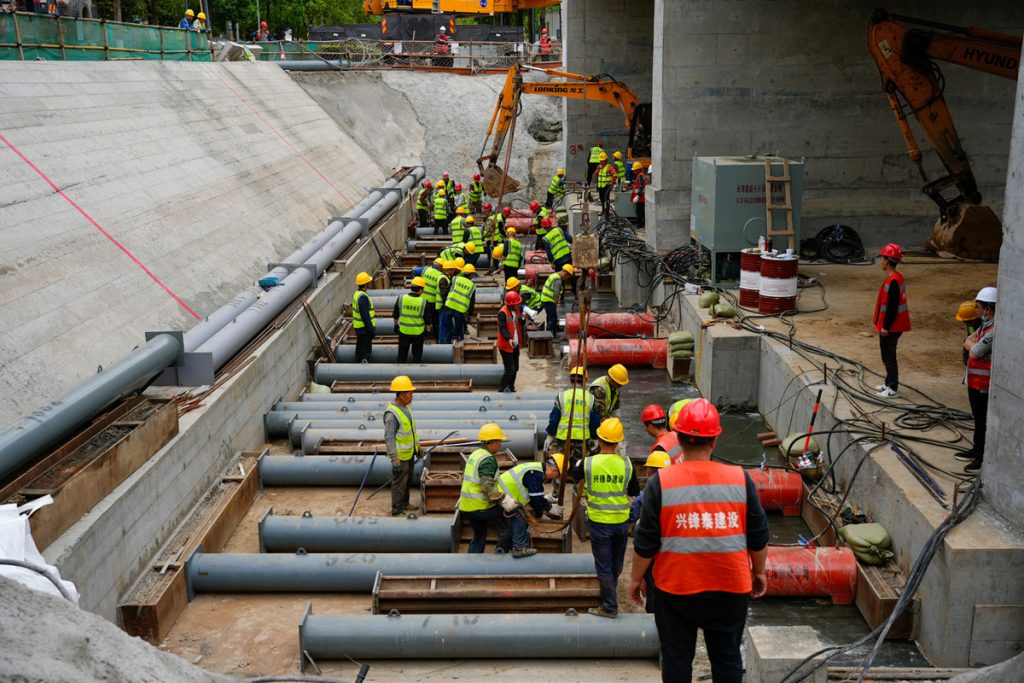
The previous bridge weighed approximately 650 tons. To remove it, seven 200-ton hydraulic jacks operated in synchronization, pushing the structure as if it were a giant building block.
Soon afterward, the most impressive stage of the operation began.
Eight 500-ton hydraulic jacks worked in perfect coordination to slowly push the new 2,500-ton structure beneath the railway tracks. The movement was carried out gradually and with centimeter-level precision.
Train Service Resumed After Just 24 Hours
Just over a day after work began, the operation had been completed.
The old bridge was removed, the new one was installed, and the railway line was restored. Shortly after the emergency work concluded, a train successfully crossed the railway, proving that the infrastructure was ready to return to normal service.
Although many reports highlighted that the bridge was installed in just one day, the full expansion of the roadway still required additional finishing work.
According to information released by the Chinese news website CBGC, the completion of the new four-lane roadway passing beneath the railway was scheduled for the end of June of that year.
Benefits for Residents, Tourists, and the Local Economy
In addition to reducing congestion, the new infrastructure is expected to significantly improve access to Heishi Po Forest Park via Central Forest Road, one of the region’s most important scenic routes.
Local authorities say the expansion will facilitate travel between the urban center and protected environmental areas, contributing to the city’s economic, tourism, and logistical development.
According to Li Bing, a specialist with the Chengdu Project Department, the completion of the project will help relieve regional traffic pressure and improve vehicle flow along one of the busiest sections of the area.
Internet Users Were Impressed
The speed of the operation quickly went viral across social media platforms and online forums.
In a Reddit post, one of the most popular comments captured the astonishment felt by many observers:
“I wonder how long it took them to do all the preparation work so everything could happen so fast.”
The observation highlights a detail that is often overlooked in projects like this: although the installation itself took only 24 hours, months of planning, structural fabrication, and logistical preparation were required to ensure the operation could be carried out without complications.
A Symbol of Modern Engineering
Today, while trains continue to pass normally along the Guangda Railway, the new structure stands as an example of large-scale planning and engineering.
The operation marked China’s first successful test of replacing a structure of this size using giant hydraulic jack systems for rapid removal and installation.
More than just a roadway project, the undertaking has become a symbol of the country’s ability to execute major infrastructure projects in record time, demonstrating how technology, planning, and coordination can dramatically reduce the impact of complex construction work on the public.
Image credit: Chengdu Railway Department of China, via CBGC
Sources and References:
- CBGC (Sichuan Online): Official coverage of the technical details and construction schedule in Guangyuan. Available at: cbgc.scol.com.cn.
- People’s Daily Online (English): International report detailing the rapid railway structure replacement operation. Available at: en.people.cn.
- Reddit Forum (r/interestingasfuck): International impact and discussions regarding the engineering of the operation. Available at: reddit.com.